I just started last month twice a week with indoor training after a long time injury.
The Adaptive Training Program tells me i have to do 2.3 hrs Weekly Training but it continues to give me 45 minutes workouts. Shouldn’t i be getting 69 minutes workouts?
It might be easier if you include a screenshot. The durations are only used for information, internally Xert schedules recommends a xss load (low, high, peak) every day. How long time it takes depends on the intensity of the workout. For low XSS, this can be achieved by doing zone 1-4 (everything sub TP), and the XSS is accumulating faster the closer you are to TP.
@hpbieker is spot on! The weekly hours are estimated for you based on your current training load, your improvement rate, & your usual activity. Xert doesn’t prescribe or recommend training based on duration, but rather on XSS, which indirectly accounts for duration, intensity, & fatigue.
For example, Xert might recommend 90 XSS for today’s training.
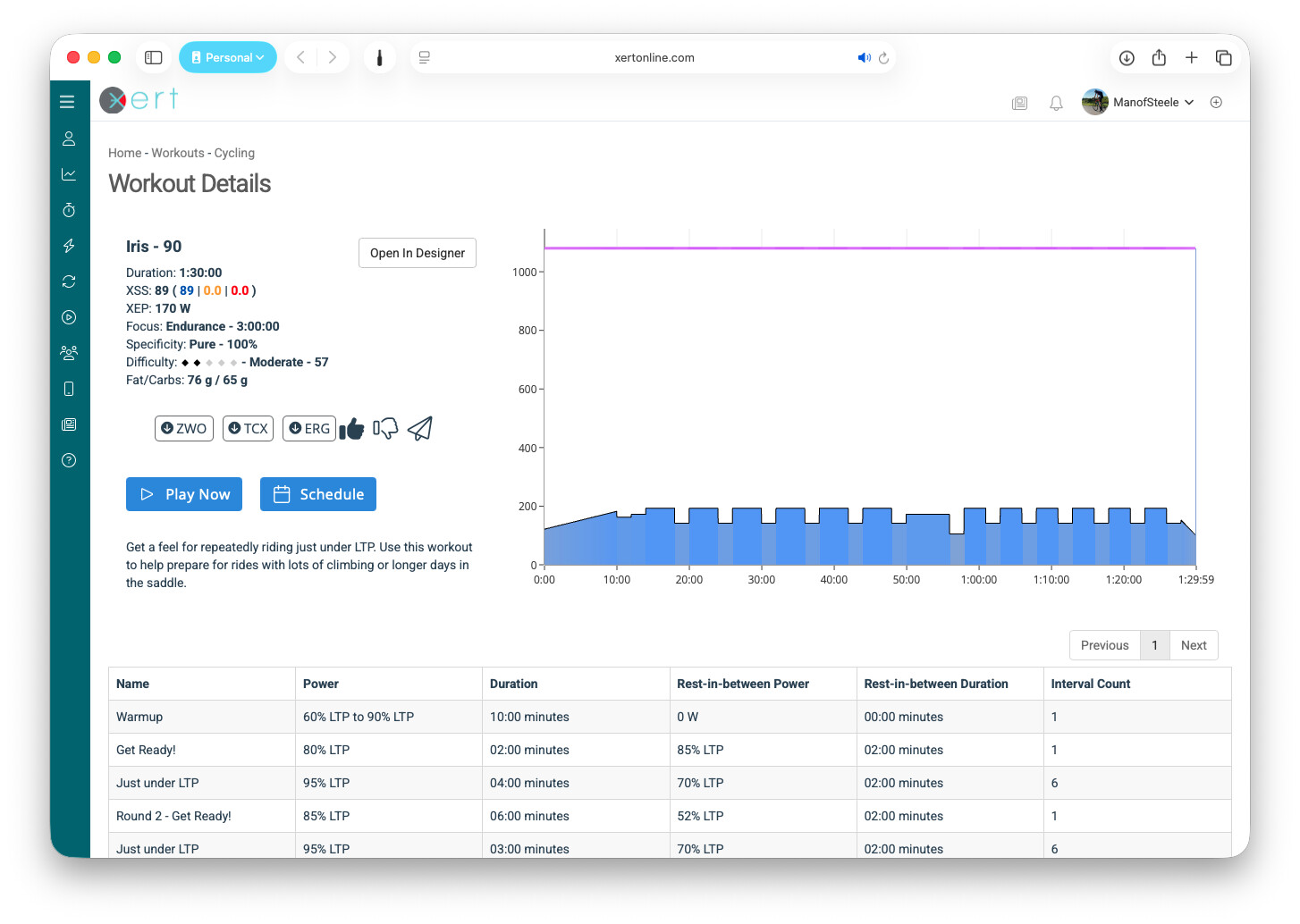
I could select a moderate endurance workout like Iris - 90, and it would take me about 90 minutes:
If you’re selecting & completing workouts that align with the recommended XSS, that’s ultimately what Xert cares about, not duration. If you’re able to achieve the workouts easily within your available time, you could try increasing your Improvement Rate. Cheers!
When selecting a workout, use the filter options to limit the difficulty of the workouts recommended to you. The lower the difficulty, the less intensity, however, they will last a bit longer in order to achieve the required XSS.
You will normally get workouts with the closest xss match as possible. This means that if you have a low intensity workout on the plan (only low xss), low intensity workouts will be listed first.
As mentioned by @Chop_Stick , you can filter based on difficulty, but the granularity is probably a bit coarse. For endurance you probably want to stick to two diamonds unless you want to do tempo/threshold/sweetspot.
You can of course also set a minimum duration. That will typically make it easier
Go to Program settings and select XATA Base-Build-Peak with the default target date 120 days from now.
That will start a phased progression and place you in Base phase for the next 45 days (starting tomorrow).
Only Endurance level workouts will be recommended (XSS = X Low, 0 High, 0 Peak).
You can use the Duration filter to ride more or less today as your schedule and form allows.
The Training Pacer reflects a weighted-moving average XSS over a rolling 7-day window.
As long as needle is in the 11am-1pm position you are “on plan” according to the ramp rate currently configured.
In your case you could set Improvement Rate to Off-Season and ride as you like ignoring the Training Pacer. However, it will point up if you are consistent from week to week.
The following question may be a little off-topic, but I think it fits quite well here.
I am currently in the pre-base phase of preparing for an event on May 30, 2026. I am using Forecast AI for this.
At the moment, my daily training sessions are still quite short. But that will change at the end of February.
In order to be able to cope with the training workload, I am considering incorporating my morning commutes to work (usually twice a week) into my training.
Now my question:
How does the AI deal with fragmented training (7:00-7:45 a.m. base, 3:00 p.m. - open-end)? Is it okay to split up a 3-hour training session? Or should I really ride for 3 hours straight?
I am training for a 320 km ride. Approximately 920xss, Focus breakaway Specialist, Specificity Mixed Some threshold
The good thing with Xert: everything counts as long as you record power. You can get your desired strain with split-sessions.
But splitting your sessions will reduce “difficulty score” of each session more than half. Two one-hour-rides are less difficult than a single two-hour-ride. Xert separates difficulty from strain.
Your event looks quite difficult for most people, so you might still want to implement some more difficult sessions to train your resilience. If you never ride 3-6 hours in training straight, you will get into issues with your central fatigue when the event has 10-12 hours of riding hard.
As they put it: “You may have the power to continue but the pain & discomfort is too much for you. Exhaustion is overwhelming and you simply have no desire to continue. Sometimes your body overheats and it’s unbearable. Sometimes you simply lack the motivation to continue.”
Magic Buckets helps you to get your XSS in and as long as you let the gamification motivate yourself, you might also get your difficulty score up.
It all makes sense, and I will take it into account in my training.
What I really like is the reduction in the difficulty score.
This allows me to do a “relaxed” commute in the morning. I can complete this activity and upload it to Xert. And after work, I can do an updated, more difficult ride (with detours, intervals, etc.).
It’s not possible for me to do many long rides during the week. Three hours shouldn’t be a problem. But a continuous 4-6 hour ride is only possible on Fridays, Saturdays, or Sundays.
Je poursuis le programme base/build/peak actuellement et je suis en phase de base, j’ai une petite inquiétude qui arrive, mon TP ne fait que diminuer et à priori se confirme avec des percées proches et n’arrive pas actuellement à faire de vraies percées, mon TP a diminué de presque 20W depuis début septembre et je commence à m’inquiéter car venant de trainerroad où tout était guidé, là je me retrouve à devoir choisir mes entrainements, mais avant de me retrouver dans un mur, est-ce que je fais les bons choix d’entrainements?
Trainerroad me proposait lors de la phase de base chaque semaine une séance au seuil et sweet spot, et visiblement ce n’est pas le cas sur Xert pour l’entrainement au seuil.
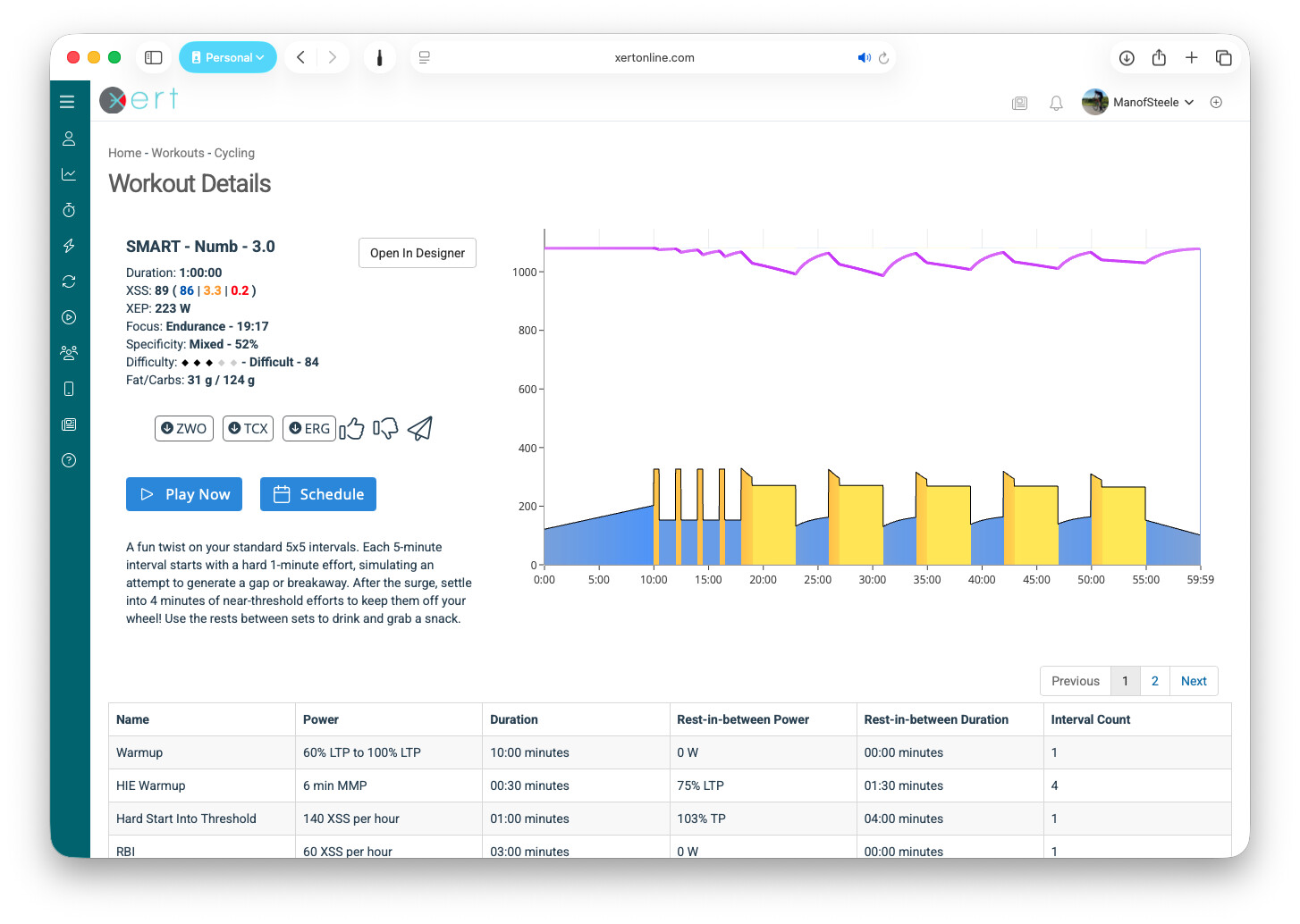
Dans ta réponse tu choisis l’entrainement Numb 3.0 en lieu et place de Iris 90, or lorsque je veux faire ce choix, Xert me dit que je suis hors focus, donc je ne choisis pas cette entrainement, ai-je fais une erreur ce dernier mois d’entrainement à ne pas faire de seuil en phase de base? Car 20w de perdu me semble énorme, et j’ai peur d’avoir raté une occasion de passer un palier par rapport à l’an dernier et d’avoir pris finalement du retard pour la saison à venir.
If you have a Garmin head unit Magic Buckets on a Garmin supports split workouts that count against the total XSS goal for the day.
You’d complete and upload the commute activity in the morning. Then on the next ride the low/high/peak from the commute would show up on XMB along with remaining low/high/peak. Follow the XMB guidelines to fill those buckets.
In this scenario you wouldn’t assign any workouts to the Planner. XMB will use the top-level XSS goal for the day.
For example, on a LIT day where 120 XSS Low strain is the goal the commute might accumulate 45 XSS and the latter ride will have 75 remaining.to fill the Low bucket.
On a HIT day you could ride easy during the commute (Low XSS) and leave the intervals for the second ride. In this case you’d ignore the interval guidelines shown on XMB during the commute and ride easy. After work you’d tackle the intervals.
When you select BPP (Base-Build-Peak) the first 45 days are all endurance as the Focus target.
Many riders prefer to stick entirely with endurance level rides during Base phase.
You can eliminate signature decay during that period by changing Decay Method to None under Profile Settings.
Change back to Optimal during Build phase.
This assumes your signature is already dialed in before you change the decay setting.
In your case you want to reset your signature first.
At any time – during any phase – you can test yourself and validate your signature by trying for a Breakthrough (BT).
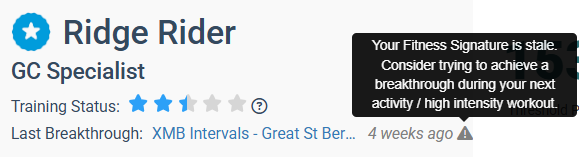
You’ll notice on the Training page a warning icon appears when your signature has become stale –
Indoors you can select one of the fitness test workouts like this one.
Ride the workout entirely in Slope mode using gears/cadence to hit targets or exceed them. Smash your pedals on the two short sprints (stand if you want) plus make sure to ride to complete failure on the last longer interval.
Click HERE for details on all the fitness test workouts. You’ll likely find a favorite over time.
Performing a fitness test will reset your signature if decay has lowered values during an extended period of LIT.
You can then set Decay Method to None and changes in signature will reflect changes in Training Load alone. Or leave at Optimal and periodically test yourself on a HIT day when you’re feeling especially fresh and ready for a few maximal efforts.
When you reach Build-Peak phases decay is offset by the HIT activities you’ll be doing but you can always test yourself when you feel up for it.
What many athletes eventually come to appreciate with Xert is that there’s no single “magic” workout - or even a perfect combination of workouts - that builds fitness on its own. While some workouts are better suited to specific types of fitness (e.g. Sprinting versus Threshold), it’s really the strain you accumulate over time measured by XSS (Xert Strain Score) that drives improvement across your 3 energy systems.
At its core, fitness is built through progressive overload. That means doing more than what your body is currently used to. Think of it like strength training: if you lift the same weight every week, you’ll eventually plateau. To improve, you have to increase reps, sets, or weight.
In Xert, the equivalent is doing more Low, High, and Peak XSS than what your current Training Loads are, since those represent what your body is currently “used to”.
That’s where your Improvement Rate (in XATA) comes in. It adjusts your weekly training volume to gradually apply progressive overload.
If your training load (Low, High, Peak) is increasing, your fitness (TP, HIE, PP, respectively) is likely improving.
If your training load is declining, you’ll likely see a drop in fitness.
If it’s flat, you’re in maintenance mode and won’t see much change either way.
So even if you’re doing great workouts, if your overall training volume or strain isn’t increasing, you’ll eventually plateau.
Without seeing your data, I’d suggest reviewing your current Improvement Rate setting. Try bumping it up for a week or two - something like Moderate-2 is often a good balance or improvement without requiring excessive recovery.
Ceci dit je me pose la question comment devrais-je faire pour limiter cette perte de watts, ai-je fais une erreur sur le choix de mon programme? Puis-je changer en cours de route, je crains de partir plus bas que l’an dernier et pourtant je n’avais pas la sensation de m’entrainer autant avec trainerroad, les projections de Xert en volume me semble plus importante pour un résultat projeté moindre, mais peut-être que je pense mal car je n’ai pas encore tout compris de Xert.
Existe-t-il un moyen de faire un entrainement avec magic buckets mais en choisissant manuellement la quantité de xss low, high et peak?
Merci pour votre travail et le temps que vous prenez pour nous expliquer tout cela
Not necessarily - you might need to determine if your fitness is actually lower, or whether the signature values displayed are underestimated… your signature will slowly decay down over time if you haven’t pushed yourself hard in some time. You might find that if you push for a hard effort, you’ll get a breakthrough that brings your numbers back up. Generally speaking, if you’re training consistently and your training load is increasing, then we expect your fitness to be gradually increasing as well. That depends on all the data you’ve uploaded to the system and updates as you continue to load new rides!
Absolutely! Xert is designed to be flexible and allow you to change training goals/availabilities and even the focus of your training. In fact, you should be adjusting things like your improvement rate if you’re finding that you have more time to train & you want greater improvement, or you might need an easier week (so decrease your Improvement Rate temporarily).
Some other systems like to use grouped data & machine learning to make estimations on grouped data, but Xert’s estimations are based only on your data that you’ve uploaded to Xert. The values are often a bit conservative. You might find that you’re able to surpass the projections before the end of the program by getting a breakthrough - if that happens, congrats! You’ve exceeded the plan & you can then come up with a new target & reforecast your training!
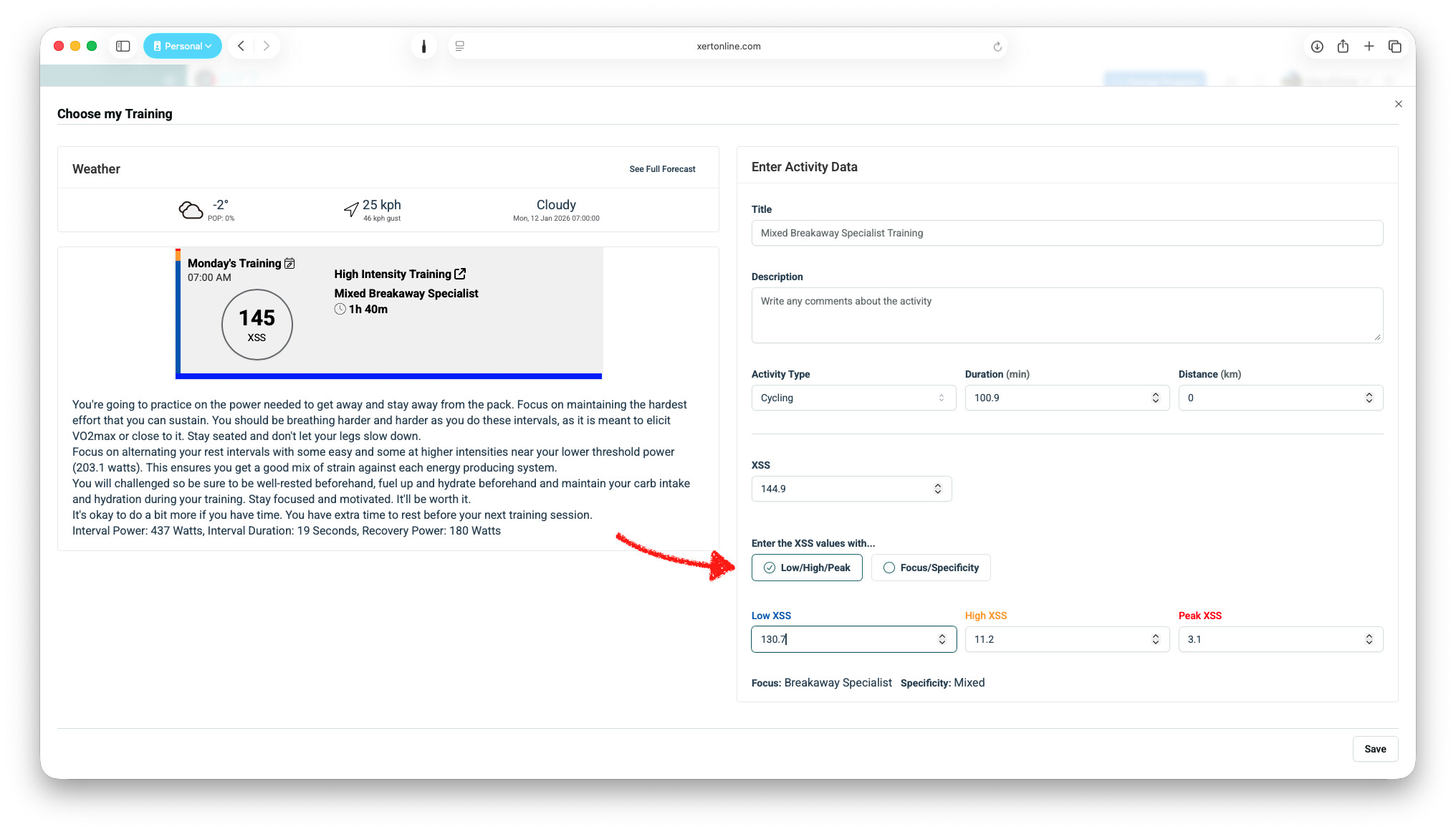
Yes! If you go to the fitness planner and open the recommended training on a placeholder (or click the + button if you’re on an XATA program), select the “Manual” tab on the right (shown below):
From here you can either manually key in the Low, High, & Peak values that you wish to achieve on a particular day, or specify the XSS total and choose a Focus/Specificity (Xert will auto-calculate the L/H/P values for you). Note that there are some limitations in the combinations that can be used - you can experiment with different values to see how that impacts the calculated focus & specificity of the activity.
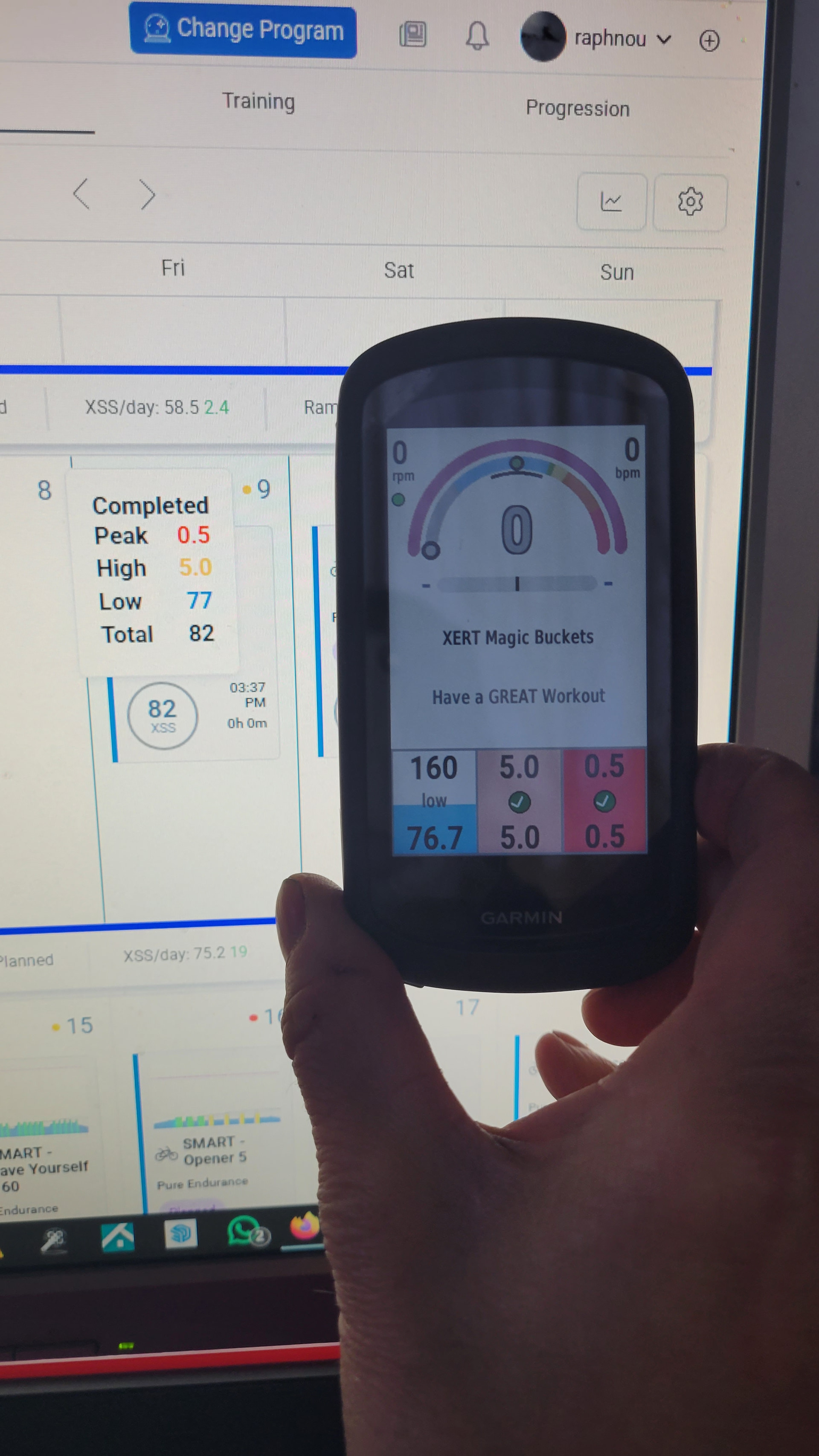
Pour ce qui concerne les MB, j’avais déjà essayé la fonction manuelle mais je ne comprends pas pourquoi sur xert MB garmin, il indique les valeurs High et Peak comme déjà réalisées au démarrage du gps, du coup je ne comprends pas la démarche pour faire l’entrainement.
voici une photo du planning pour aujourd’hui et MB garmin qui sera plus parlante