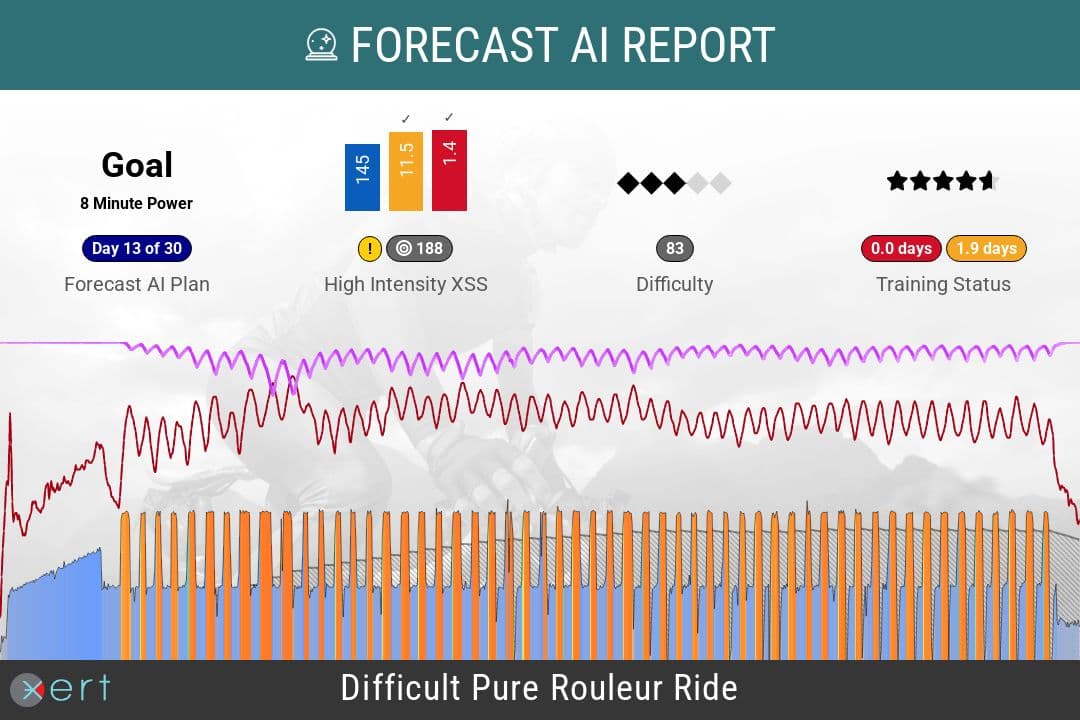
Hello all,
When using Xert Magic Buckets, when is it advisable to change the interval duration? Or is it simply better to leave it as it is?
Thank you very much!
Hello all,
When using Xert Magic Buckets, when is it advisable to change the interval duration? Or is it simply better to leave it as it is?
Thank you very much!
You can play with the challenge level and duration to complete the workout in shorter time and ensure the difficulty score it not too high
I typically use the Next and Previous button in the workout player to extend the intervals or shorten the rest intervals during the workout. And the do the remaining low XSS at the end (by monitoring the values in XMB on the Garmin Edge).
Great question! By default, Magic Buckets sets the default interval duration based on the time it would take to move up about 1.5 Challenge Levels at the target power. That said, the duration is adjustable if you want to experiment with different lengths of intervals.
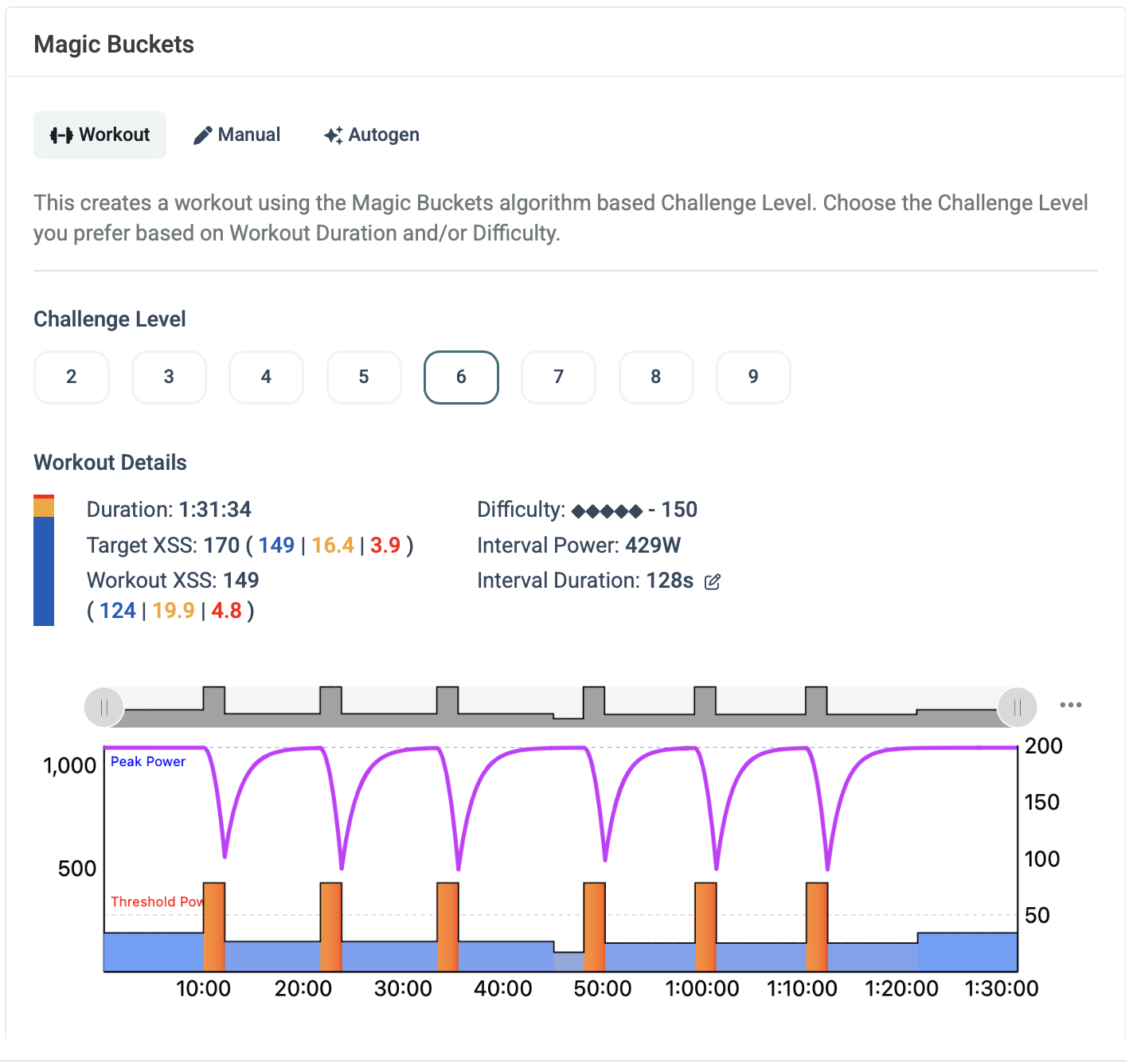
A key thing to consider: if your Peak XSS target is high, the interval power will be well above threshold, and you might reach your MPA (i.e. your limit) very quickly (i.e. you won’t be doing 20 min Magic Buckets intervals). Holding efforts that bring you that close to failure - especially repeatedly - can quickly ramp up the difficulty and may make the session feel impossible to complete. I tried maxing out the interval duration for one of my upcoming high intensity days and the result was 6 near-maximal intervals - ouch!
In those cases, shorter “micro-intervals”, like what Xert usually recommends, can be much more effective. The brief recoveries allow you to hit high targets repeatedly without fully exhausting yourself, which aligns well with how the system builds Peak and High strain. We didn’t design the system to lean towards micro-intervals, but that’s how the math works out and aligns well with well-known types of micro intervals (20-10’s, 30-15’s, 30-30’s, 40-20’s, etc).
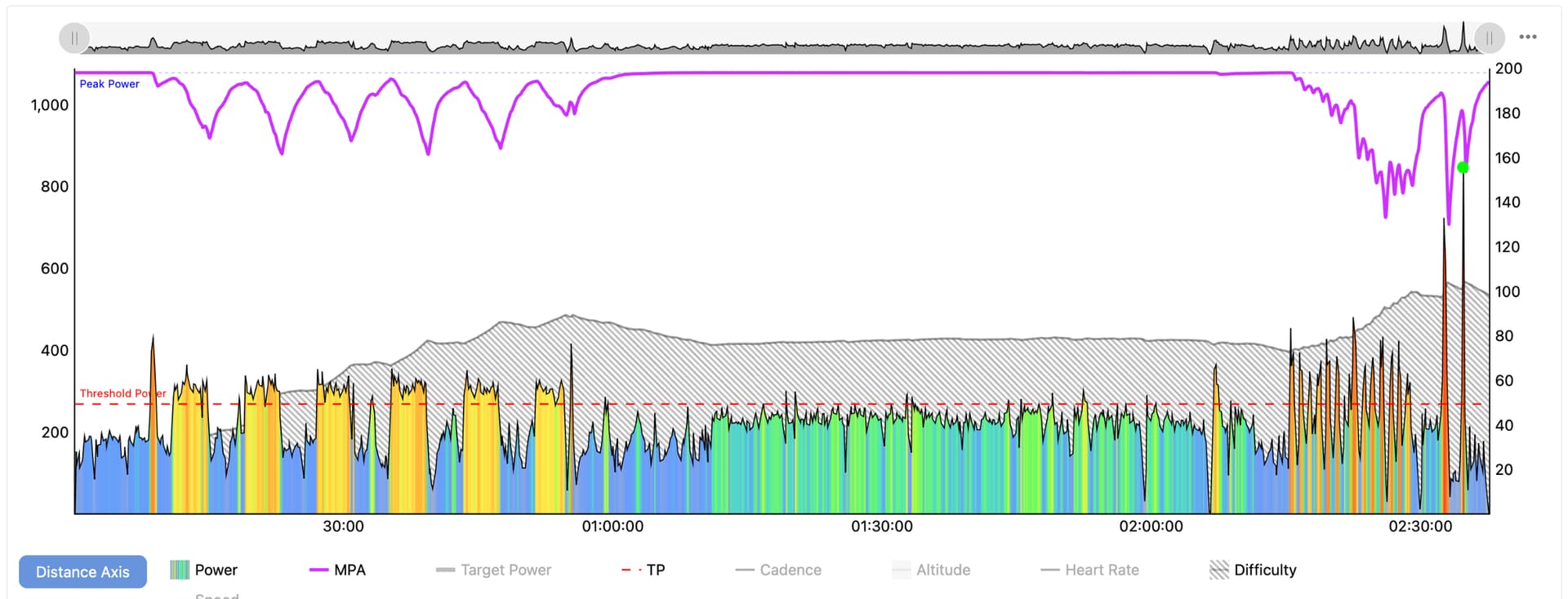
Personally, when I use Magic Buckets data field on my Garmin, I’ll sometimes start with longer, more steady efforts closer to threshold, then “top up” with some shorter, higher-intensity efforts at the end - especially if I’m behind on Peak or High strain. Here’s an example from last weekend:
Another tip: if you do a few short sprints early on, you’ll partially fill your Peak bucket. That can shift the target interval power closer to threshold, effectively making the upcoming efforts longer and at a lower intensity.
So in short… you’re feel free to experiment, but it’s usually best to leave the default unless you want to slightly extend (or shorten) the intervals.
Thanks to both of you for your answers. I’ll play around with the duration to see how it goes. I understand this feature better now.
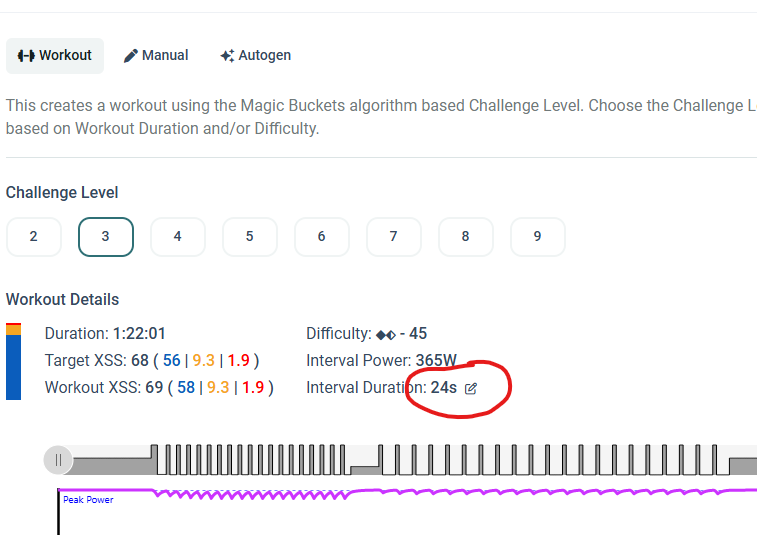
The default entry will display suggested target watts and duration at the prescribed Difficulty level.
In this case approximately 365 watts at approximately 24 secs with easy pedaling in between with an expected Difficulty level of 45 XSS per hour (1.5 diamonds). That rates as Easy HIT.
Watch what happens to MPA drawdown line, rest-in-between, and interval duration when you tap CL 8. The activity duration estimate will shorten with a rise in XSS per hour (higher difficulty).
Zoom in on the chart and hover over the intervals and you’ll see their duration has increased while RIBs (rest-in-between) have shrunk. The duration seconds change isn’t obvious unless you zoom in and hover. [@ManofSteele Is this something to fix?]
If free riding with XMB outdoors on a Garmin or Hammerhead unit you can vary target and durations to suit terrain and traffic. The XMB app will adjust accordingly to help steer you into filling the high/peak buckets at a similar rate.
If you have a Wahoo you can send the XMB generated workout to your head unit and roughly follow the guidelines to achieve the Focus and Difficulty target for the day.
You can up the intensity during a ride by raising the interval duration. That corresponds with a higher CL. If you maintain that effort it would push you into Moderate Difficulty territory (50-75 XSS per hour; 2 to 2.5 diamonds).
Indoors you’ll likely adhere to the workout structure in AUTO mode (ERG control) but you can vary the effort by switching to Slope mode.
On Android EBC you can alternately start an indoor session without selecting a workout and rely on XMB page views to fill the low/high/peak buckets at the CL you prefer.
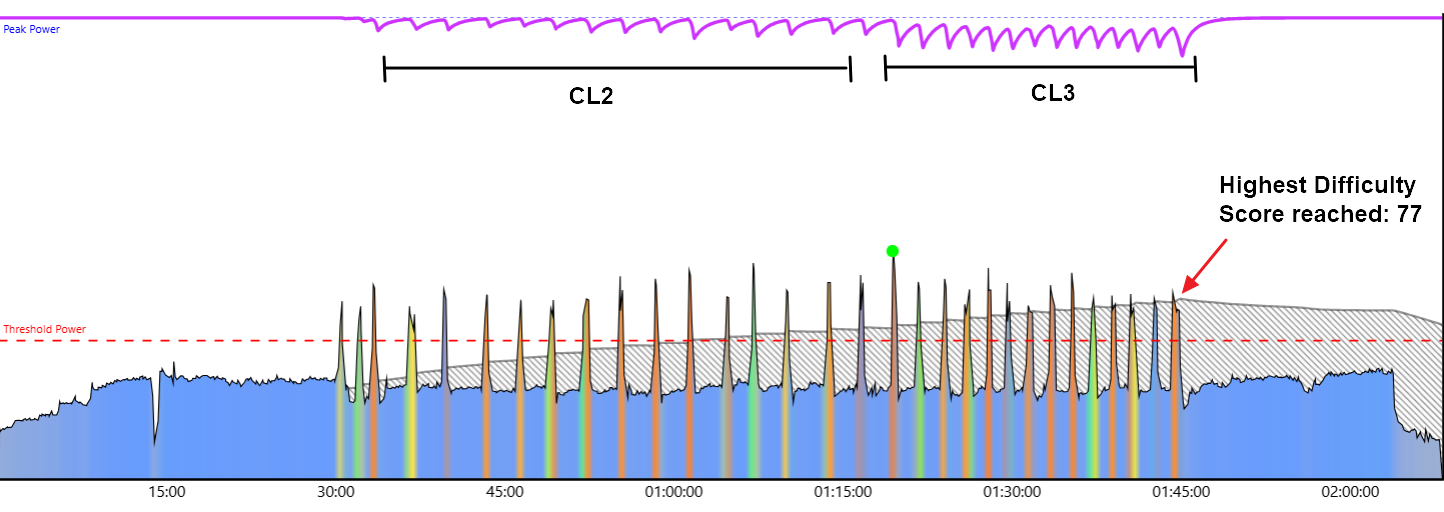
You’ll also discover you can monitor the CL gauge alone to control the intervals and difficulty level achieved. For example, here’s my indoor XMB session yesterday where I warmed up for 30 minutes, stuck with CL2 for a while, then upped to CL3 for the remaining intervals. I wasn’t so much watching the seconds as I was waiting for the CL gauge to reach 3 before ending the interval. The result was a Difficulty Score of 77 (3 diamonds) which is just above a Moderate rating.
You can raise Difficulty even higher by not waiting for the Recovery countdown timer to reach 0 which means MPA will remain drawn down a bit when starting the next interval.
Is time at VO2max not a thing for XMB at all? I try to reach 90% HR with 5-6 harder/longer intervals in the beginning and then keep it roughly there until my legs cant do it anymore. Otherwise i could do a HIT-workout with 0 time at VO2max, which seems odd to me. What’s the idea behind that?
You could also do that with Magic Buckets, but you’ll likely only achieve very high percentages of HRmax by doing your Magic Bucket intervals at a relatively high Challenge Levels (I’d guess at least CL 7).
You can experiment… try to get yourself to CL 8 or 9 and then keep your CL up there. I suspect you’ll be very near (or above) 90% HRmax that way. Microintervals are well documented to increase time at high percentages of HRmax/VO2max compared to continuous efforts. This study by Billat (here) was done with runners, but you can imagine that the results would be similar for other aerobic sports, like cycling.
Personally speaking, most of my past activities that included lots of time around ~90% HRmax were often micro-intervals that brought me very near failure, which would correspond to Challenge Level 9-10 when using Magic Bucket intervals. It is important to note that we didn’t set out to design XMB to give short intervals, but the math we uncovered behind the algorithm showed that they’re a very efficient way to fill your buckets. 
Cheers!
thanks for your reply, but do you think time@>90%HRmax does even matter? Or does only XSS matter and will you get the same adaptions without reaching the pain of almost drowning in VO2max area?
I love the idea of xmb for my outdoor rides, it is a big relief being able to adapt to traffic and hills. I start my bouts when i feel i can do one more, i stop them before i go into failure. Level varies throughout the workout as the roads i am riding. But i am struggling with this idea that “strain can give you gain without the pain”. If it gave the same adaptions, why should i even hurt myself this much? 
I understand that XSS will try to make up for it by increasing time in power zone when MPA is kept quite high. But as far as I read the science and even the study by Billat you posted, it seems to be the main goal of HIT to increase time at VO2max? So do you know any study or anything that says: HIT it is just about getting the strain in? Maybe you can have this discussion (time@VO2max vs. XSS as goal for a HIT-Workout) for a podcast? I would be very interested.
I think the assumption «without pain» is not correct. Doing 50-60 repeats of 40 sec @ 380 W (or whatever) is still going to hurt at the end of the workout.
But maybe there is a difference between local muscle strain vs strain in the cardio vascular system? So with a lower hear rate (because of a lower challenge level), you do not get the same improvements in heart and lungs, but you do get the same improvements in your legs?
VO2max is a physiological state you want to reach and hold for X minutes.
Both traditional straight blocks (ex. 5x3@105-120%) and micro-intervals (ex. sets of 30/15s or 20/10s at higher watts) will push you into that state.
XMB lends itself to the micro-interval method.
Either way you will be breathing hard and feeling the pain of a VO2max effort.
The high rate of XSS accumulating ensures that.
There is a recent study (don’t remember the link) that proposes micro-intervals may be better for elite athletes with high VO2max values already.
Regardless where I fall in the pecking order, I’d rather attempt micro-interval sets outdoors than perform straight blocks. I tolerate the required effort best when peppered with short breaks. YMMV
Indoors I’d select a SMART VO2max workout from the Closer series like this one based on XSSR. Or Elastic Heart based on % Reserve MPA. Both scale the effort to your fitness signature.
You could try to replicate that style interval outdoors as terrain/traffic permits.
Either way XMB high/peak buckets will get filled at the intended VO2max intensity as long as you push yourself to that level.
thanks for your answers. What I will take away: XMB does not care if you reach VO2max. This is not part of its algorithm. XATA / XAI will just have a look on my training loads and (theoretical) recovery needs. The rest is up to my (poorly) educated self. XMB is built for filling buckets the most time efficient way, not the most “time at VO2max” efficient way.
But XMB expects/leads the user trying to reach the highest level possible in their workouts so that they maybe extend their time at VO2max as they progress.
Practical advice to myself: start with aiming for lvl 6/7, aim +1 each session until I have reached lvl 10 (breakthrough), start with 6/7 again and raise again.
On the micro-intervals/steady state intervals: as far as I understood, focus power is just broken down to a given ratio between XHSS and XPSS. XMB will suggest very hard very short intervals (way above 120% TP or what “normal” HIT-Programs will suggest) as it calculates them as the most time efficient way to fill both buckets. But as long as I am above threshold, I can do as “easy” and as long as I want. I can go for several intervals of 8 mins@105% FTP and finish with some short sprints later on. I can go for some warmup-sprints and then finish with several 5 min efforts. Workouts’ focus power will later be calculated from the ratio between XHSS and XPSS - even when you never rode at that specific focus power.
btw: I just realized how this “just strain, no pain, same gain” workout came to my Garmin: I had a 4 hour ride planned by XATA and XMB lvl 2 proposed something like 24 intervals of 20sec with 10 minutes recovery between each (XATA set to “time trialist”)…
Did my warmup, filled Hi and Peak within 15 minutes and went low intensity for the last 3 hours.
A workout like the one below is a good example of an XMB session where your heart rate might not reach VO2Max, but where you still achieve the same high and peak XSS.
I’ve set up a template workout in Xert that I use as a base. Before each session, I simply adjust the target power, interval duration, rest duration, and number of repeats. During the workout, I just follow along on my Garmin Edge.
If I feel I still have something left towards the end of an interval, I just press rewind to keep pushing a bit longer. When I’m done, I press next and move on.
I can promise you—after completing all the repeats, your legs will definitely feel it. Even if a single interval doesn’t feel that tough, they really add up over the course of the workout!
@FJorquera I never realised that you could adjust the duration, but that comes down to the way I use the buckets and why I really like this addition to XERT.
for rides where intervals is prescribed I always go to the same routine
first then I look at the Buckets and start doing the required intervals, and execute them as I feel suited and the roads allow. The above procedure is a consequence of the transport I have to my preferred training area and yours will for sure differ. As for the intervals, I find the very short intervals/rbi’s difficult to do on public roads and tend to do short high peaks on a closed airfield, bringing the target power down and then do 2 min intervals. All above done while looking at the challenge level.
if entire duration is longer also try to split the collection of points in two equal hard parts. Doing high and peak point after 2 hours of LTP is for sure different than doing them all in the start of the training.
Regarding VO2max. I had the same concerns when I started with XERT coming from traditional 40/20 at 5min power, but I found that my 5min power had increased while doing the XERT workouts. Depending on the training goals and time available I always find that the difficulty of the suggested workouts increase to a level where you will spend time in VO2max, especially if the focus of the workout is 4/5 mins.
zero pain - more gain is in my view only possible until you run out of time. Usually all my interval days ends up being difficult or hard, with the easy sections between the interval blocks being done with much higher power in order to accumulate the low points I need.