Why are so few workouts with %MPA?

Hej there,

in about two months of training with XERT I think I exclusively got prescribed workouts with XSS/hour. As far as I understand the big advantage of training with MPA next to the analytical insight is modeling workouts to really get to a certain degree of fatigue and also giving a much more individual recovery window.

With XSS/h power will drop the longer the interval goes, but it never brings me to a certain degree of fatigue. Recovery is also given via XSS/hour, so not even that is really with a certain point on my MPA curve in mind.

In episode 4 of the podcast at ~11min it is said that SMART intervals could/should be modeled with the goal of a certain MPA instead of fixed time/power - but they rarely do.

So my question aims to get a deeper understanding is simply: why is that? :slight_smile:

Thanks and cheers from germany
Daniel

There is range of suitable workouts on recommended lists to choose from on a daily basis.
If you’ve enabled Automatically Schedule WOTD (workout of the day) that routine randomly selects from top entries, but you can always override the selection at the last minute if you’d like to ride something else.

Many workouts in the Library include SMART intervals that are not anchored on TP.
One type includes dynamic power and duration intervals defined by XSSR and %MPA Reserve.
Most dynamic workouts in the Library have been converted to be power based rather than duration since users were perplexed when the 60-minute workout they selected wasn’t 60 minutes. :smiley:
If you’d like to include some dynamic duration workouts you can easily create them by opening an existing workout in Workout Designer, select Copy, then define appropriate intervals with an MPA option.
You can also import workouts sourced elsewhere and Xertify them which automatically defines SMART intervals during import.
Created or imported workouts are added to your Personal folder and show up on recommended lists when suitable for the day’s goal.
Reference – Advanced Workout Design using SMART Intervals – Xert

When your signature is dialed in MPA drawdown fatigue will be obvious on hard workouts especially those that exceed your current status stars level. E.g. selecting a 3.5 diamond workout when you are currently at 2.5 stars will be harder workout to complete at 100% compared to a matching diamond count.
Another way to confirm your signature is in the right ballpark is to ride over/under LTP and over/under TP workouts. Search for “over/under” to find them.
If the sets don’t feel like over/unders you’ll want to validate your signature. That might be with a fitness test workout in Slope mode or a similar effort outdoors or with a manual adjustment if necessary.

1 Like

Thanks for your answer. My question is more of a philisophical one though, so let me rephrase it:

Intervals with %MPA are advertised via XERT as superior to %FTP workouts. When this is true, why does the workout library not reflect that? You already mentioned dynamic duration is perplexing to users. I’m pretty sure it is, but is this the only reason for that? On the other hand if you’ll get promised superior outcomes (GET FASTER THAN YOUR MATES :zany_face:), wouldnt it been worth it to plan around instead of just not doing it?

Regarding dynamic power/XSSR intervals: while giving the opportunity to make intervals dynamic in nature, the advantage of %MPA to have hard intervals go to almost your limits (without overstepping and therefore overly fatiguing you) seems to be missing - just the same as when doing %FTP intervals - the work you do is fixed absolutely instead of realtive to your thresholds and I would guess XSSR and %FTP then produce comparable outcomes.

To be clear: I would think that all of these differences are marginal gains for the recreational rider, but I’m just interested in the reasoning and thoughts behind the different approaches to building workouts :innocent:

Hi,
what frustrates me about SMART workouts is that I still cannot clearly tell what makes a workout with a SMART label actually SMART in practice.
Xert presents SMART workouts as something meaningfully beyond traditional %FTP/%LTP interval prescriptions, yet in the workout library that difference is often not visible at all from the user side.

For example, I looked at SMART - Lucy in the Sky with Diamonds - 75, and the workout details show a fixed structure: warm-up, then 15 x 3:00 at 90% LTP with 1:00 at 105% LTP, then cooldown.

I then compared it to All The Small Things - 90, which is not labeled SMART, and it also appears to be a fixed %LTP workout: warm-up, repeated 3:00 at 85% LTP with 2:00 at 75% LTP, plus breaks and cooldown.

From the outside, both workouts look like conventional fixed structured workouts, so the SMART label becomes very hard to understand in practical terms.

What makes this frustrating is that Xert markets SMART workouts as something more advanced and more individualized than traditional interval prescriptions, while in practice many of them do not visibly behave that way unless the user starts digging through workout details.

I understand that Xert changed many SMART intervals from fixed power / variable duration to variable power / fixed duration so workouts would always end on time.

But from a paying user’s perspective, that creates a real expectation gap: the product is presented one way, while the library often behaves in a much more conventional way.

If a workout is actually Smart Duration, Smart Power, XSSR-based, or just a fixed %LTP session, that should be obvious from the label itself.

Right now, it often feels like users are being sold the idea of something more advanced, while many workouts look and behave much closer to classic structured training than the SMART branding suggests.

1 Like

While I think your answer slightly derails the direction I want that thread to go, I’m all in for a more refined tagging of workouts! Since users who do read into that stuff already know what %MPA, XSSR and the likes mean, why not just use exactly that as a label? If a workout is tagged “%MPA” I directly know its variable duration, “XSSR” is directly read as variable power and so on - I like that idea!

Expanding on points brought up so far…

Dynamic duration converted to power was more of a practical decision than philosophical. :slight_smile:
The time-crunched group was freaking out.

The how-to article for advanced users explains how to create DIY workouts with all the bells and whistles Xert has to offer. The Workout Designer offers an interactive way to learn how the model works and see how various interval types affect the MPA graph line and Difficulty gradient – scaled to your fitness signature – as you define the intervals.
That excerise is not for everyone though. :wink: The time-crunched also group tends to get grumpy if they have to learn anything new. “Just tell me what to do!” YMMV
As far as the SMART classification goes, I apply the term to any workout that is not exclusively anchored on %FTP/TP. That doesn’t have to be the dynamic type. There are also static SMART intervals derived from your signature.

#1 includes TP, LTP, PP, MMP, XSSR, and Target MPA.
I’d even toss Slope entries into the mix as it seems darn smart to me to switch to a resistance mode when the target is a maximal effort (whatever you can muster).

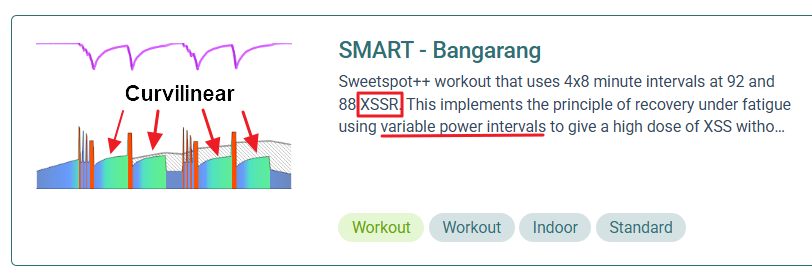
As for determining dynamic power workouts at a glance look for curvilinear entries in the thumbnail chart views. Easy enough to confirm that with one click if you’re not sure.


Perhaps an icon identifier for those workouts would suffice for those who gotta-know-right-now. The icon flag would appear if a workout contains dynamic power or duration intervals.

Here’s one of my favorite workouts that has no %TP intervals and instead relies on Ramp, LTP, MMP, MPA, and XSSR – SMART - Riders of the Storm.

Here’s a SMART version of the Seiler 4x8 workout using MMP instead of %FTP.
MMP intervals don’t dynamically change but they are certainly SMART. :wink:
Here’s a SMART 4x8 hard start version using XSSR for both work and rest intervals.
That is another unique function of SMART workouts. Besides hard start curvilinear intervals, you can define rest-in-between intervals to target a specific level of recovery before the next work interval.

The major point being with SMART intervals and a 3-dimensonal fitness signature (derived by MPA) you can design ONE workout that scales to riders of varying abilities. You don’t need thousands of workouts in the Library to individualize the target strain.
An individual’s signature applied to the same workout varies the targets to ensure athletes with differing abilities achieve the intended strain goal whether a dynamic or static interval.
The latter is best exemplified by this Academy video snippet (4 minute watch) demonstrating how a VO2max workout is scaled by using MMP.
While a SMART workout may exhibit a conventional fixed structure, the targets are not derived in the same manner.

Xert isn’t tossing classic workouts aside. If one meets the strain goal for the day, ride it if you want. There are a number of traditional workouts in the Library, some submitted by users who can’t live without them. :slight_smile: