I don’t fully understand the reasoning behind mixed and polar workouts.
For example, this Breakaway Specialist workout We Will Rock You contains intervals under and above the focus intensity of Breakaway Specialist, but none actually at the focus intensity of Breakaway Specialist. I guess that is why it is called a ‘mixed’ specificity and not a ‘pure’ specificity.
What is the supposed benefit of these mixed or polar workouts? When you want to train a certain focus intensity, it makes sense to me to actually ride at that power, and not sometimes at a power below it and sometimes at a power above it.
Also, could you not make the case that this is actually a pure time trialist workout (with some sprints sprinkled in), as that is the focus duration power that most of the intervals are at?
How does the system decide when to prescribe a pure, mixed and polar workout?
Also, as a side note, I find it really confusing that ‘polar’ is used with two different meanings: in ‘polarized periodisation’, it refers to the number of hard workouts you do per week, and in ‘polar specificity’, it refers to how much time you spent at the focus intensity.
Great question.. they’re a bit of an abstract concept and unique to Xert, since we’re the only platform that tracks fitness across multiple dimensions! Here’s the simplest way to think about it:
Focus and Specificity work together to describe what kind of fitness a workout (or activity) is actually building. They’re based on the mix of Low, High, and Peak XSS in the session.
They become most meaningful when a ride includes a mix of intensities. Pure endurance rides (mostly Low XSS) will usually just show up as Pure Endurance, which is straightforward.
Focus = “What point on my power curve is described by the cumulative efforts in this workout/activity?”
Focus mainly reflects the balance between Peak and Low strain :
More Peak XSS (hard, punchy efforts) = Shorter Focus duration
Less Peak XSS (steadier rides limiting hard efforts) = Longer Focus duration
For example:
Ride Z2 all day → you’ll see a long Endurance focus (20+ min).
Do a long Z2 ride but finish with hard sprints → your Focus may quickly drop to ~5 min, because those intense efforts shift the balance of Peak:Low strain
But here’s the key:
The second example doesn’t mean you actually rode at 5-minute power. You were either well above it (sprints) or well below it (Z2). That’s where Specificity comes in.
Specificity = “How closely did the efforts in the session resemble that Focus duration?”
Specificity reflects the balance between High and Low strain:
More High XSS → Higher specificity (increases from Polar → Mixed → Pure)
Mostly Low XSS with just a few hard spikes → Lower specificity (Polar)
If/when most of the ride is completed at the Focus Power (on your power curve), the ride has a high specificity (Pure)
For example:
Classic 30/30 or 30/15 micro intervals often end up as Pure Breakaway Specialist (5-min)… they are highly specific (and tough) because each 30s effort is done near your 5 min power with very light pedaling between efforts.
A long endurance ride with a few sprints might have a short Focus, but low specificity - meaning it wasn’t truly a focused 5-min session.. it was still mostly endurance.
Recap:
Focus = the combination of systems you stressed
Specificity = how much of your training was done specifically at that intensity (or very near it)
So if you did a 1 hour training ride most of it easy endurance (which would you improve your 1 hour power say) and you did a few hard sprints at the very end (which would improve your 20 second power), the combination would improve your 5 minute power but the specificity would be very low since only 2 of the 3 systems were under strain to improve your 5 minute power. To improve your 5 minute power with more specificity, you’d need to do the 1 hour training ride with intervals near your 5 minute power with light pedaling or even full rest in between. Then all 3 systems would be put under strain to improve your 5 minute power specifically.
Most riding and racing tends to fall at specificities near the mixed range. This means there is a lot of endurance riding and a good amount of hard efforts above TP. Hence your training should align with this. Focus and Specificity help you to understand what’s needed.
I understand that most racing is done at specificities near the mixed range. So it makes sense to also train at a mix of intensities. Will the Forecast AI take this into account? So for example if your targert race is a race with lots of different intensities, wil you get prescribed more mixed training sessions? And if your target race is a 20 minute time trial with constant power, will you get prescribed more pure training sessions?
What I do not really understand, is why a long Z2 ride with a few hard sprints will end up being classified as a focus duration of 5 minutes (with a polarized specificity). Surely a ride like that will mostly improve your endurance and peak power, but not so much your 5 minute power? So what is the point of classifying it as a focus duration of 5 minute power?
I find it informative to go to the manual activity dialogue and tinker with the Focus/Specificity options for entering XSS numbers. I can get an idea of how the Low-to-Peak and High-to-Peak ratios change depending on Focus and Specificity.
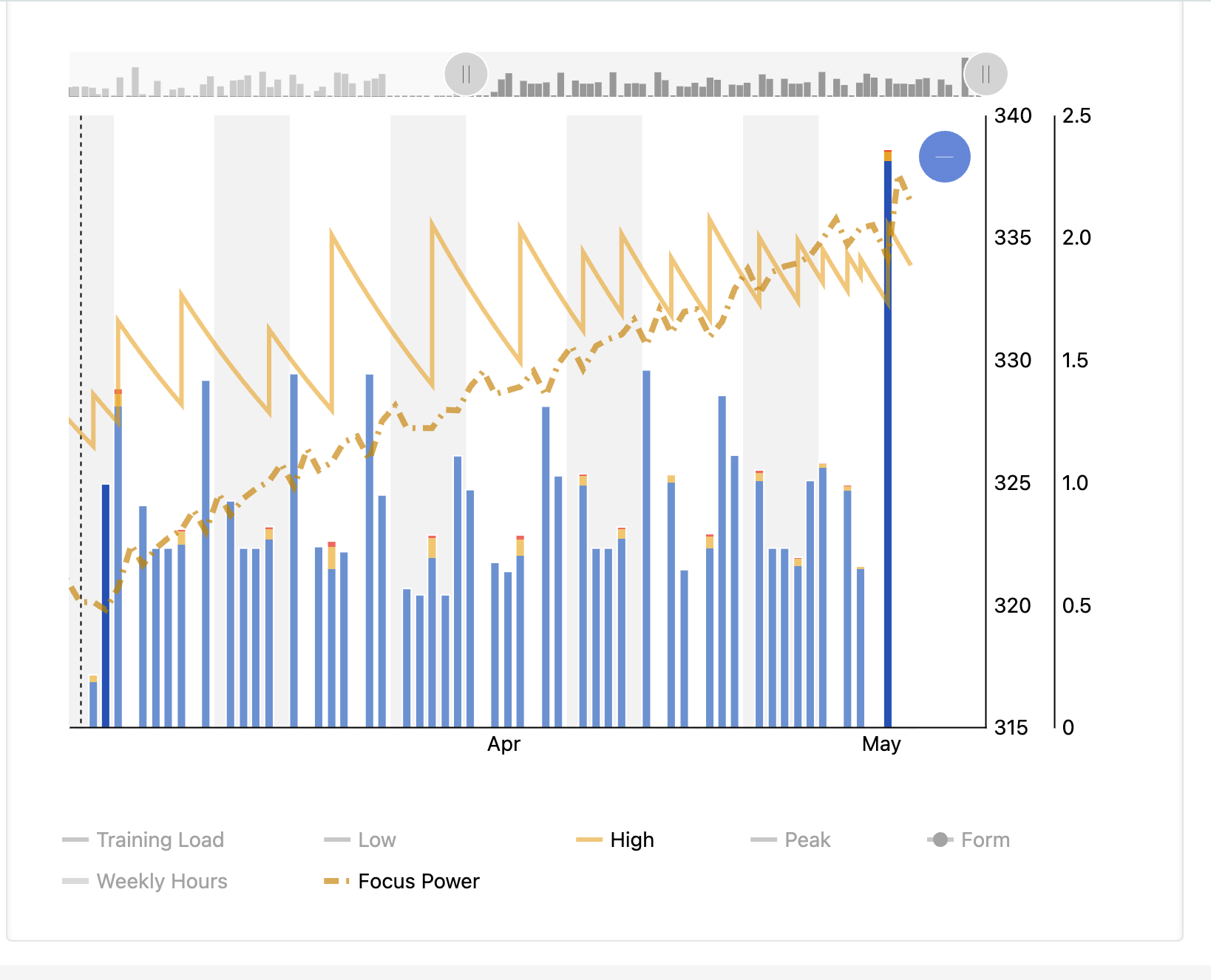
Forecast AI takes the concepts much further. It doesn’t create a generic focus/specificity plan. Instead it looks at the demands of the race/event/goal in terms of the low/high/peak XSS, fitness signature and readiness level and translates this outcome into target final low, high and peak training loads. It then maps out the low, high and peak XSS training you will need day-by-day, freshness contrained, availablity constrained and polarization-level to get you to reach your targets, hence the outcome you’re looking for. If you view the XFAI chart, you can click on Low, High and Peak on the legend to see how each system will receive progressive overload towards the target outcome.
Each training day will have it’s own focus/specificity and these may not look anything like the target’s but they play the role of accumulating the training you’ll need to reach the final target outcome you want.