I plan to to do a workout before going to work and then one after work so that I can better manage my mid-week rides around work and everything else. Everything I see on Xert assumes one workout per day for example the Weekly Availability. Does anyone do this (double days) and how do you make it work if say you do 50% of the daily XSS in the morning. Where I do this and have XSS remaining it will recommend a workout but it would be good to set double days in the Weekly Availability as part of the plan. One for Xert 2?
I don’t know how it affects Scheduled/Completed XSS on XFAI plans, but you can enable this option under Planner Settings.

2 Likes
Hey, I recently did a double workout day and had some technical issues in Xert, but you can definitely set up multiple workouts per day.
You need to use the planner / calendar if you want to schedule a second workout on a day. Hover over an empty space on the day in the calendar and click the “+” icon for “add an activity” to choose an additional workout. You’ll have to choose how much XSS you want in each workout yourself though. Use the filter options when selecting a workout to view suggestions with restricted XSS for the first workout (on either the planner or training tab). Then as you know the second workout suggestions should automatically filter for the remaining XSS.
Unfortunately the filter does not allow for specifying low/HIE/peak XSS values, only total XSS.
Maybe a “split” function would be something that might work where Xert could automatically split a chosen workout into two separate workouts.
Alternatively you could find workouts you commonly do and manually split and save them into two separate workouts, like Part 1 and Part 2, using the workout editor. It would take a while to build up a full library, but then when Xert suggest e.g. “Funeral in Carpathia” for the day’s workout, you can find and individually schedule the corresponding Part 1 and Part 2 workouts to meet the daily XSS.
Using two separate workouts at different times to complete a day’s XSS does introduce a new variable that needs to be reconciled which is fatigue / difficulty. Since you get a prolonged rest in between the two workouts, you recover in the middle of your daily XSS accumulation and the difficulty that would normally be continually rising during a single workout gets partially reset. So you would probably need slightly more XSS than originally predicted for the day. However if you have workouts on two consecutive days, then your recovery time between your evening workout and next morning workout is less than if you were doing a single workout per day at the same time, in which case total XSS could stay the same or even be reduced (possibly in exchange for an increase in a single energy system stat). Unless you have specific race targets you are trying to hit, these variables may not be important to you. You can always see how your actual fitness signature changes compared to predicted values to determine if the difference is significant.
The difficulty I encountered was because I had skipped the previous day’s workout, so decided to make up for it (punish myself) by doubling up the following day. I had a scheduled indoor trainer workout for the day, but first did an outdoor ride. The outdoor ride “completed” the scheduled workout and overrode it on the calendar. Afterwards I was unable to just start a new ad hoc trainer workout in EBC and have it sync to the web player. I ended up having to schedule the workout in the planner first and was then able to pull it up in both EBC and the player. However the player that launched was not the normal player with a video - there was no video and the data widgets were slightly different than in the normal player. I don’t really know why or what was going on with it.
1 Like
I do not think you get a very different score if you:
-
create a workout with 100 XSS over 90 min, break for 8 hours, and then 100 XSS over 90 min
-
Do the same thing as two activities. That is two 100 XSS activities separated by a 8 hour rest in the calendar.
they will not be exactly the same because in the first case 100 XSS will be completed 9 hours earlier.
1 Like
It’s the long break in between efforts that can be the problem, and specifically if doing a structured workout(s). The total XSS is just the sum accumulated for the day, but individual structured workouts build stress through repeated intervals which increases the longer the workout goes, and the most valuable intervals are those in the second half of the workout when a body is no longer fresh.
If you split a single structured workout into two parts, you definitely lose some benefit from accumulating stress under fatigue, since fatigue gets partially reset. The difference should be less if you do two separate structured workouts start to finish, where each workout is responsible for building its own fatigue levels, and there might actually end up being a higher accumulation of one specific energy system metric. However I think it gets questionable again if you consider what the goals of the day are - e.g. if you are supposed to be working on 10 minute power, are two 45 min workouts separated by a break really going to build 10 min power equivalent to one 90 min workout? I don’t really see those being equivalent since you get to recover from fatigue in between. If you take a long break in the middle of a race, you are going to be fresher in the second half of the race than if you didn’t.
It’s definitely not clear to me though if two shorter workouts, one in the morning and one in the evening, repeated every day through the week would accumulate more stress than a single workout done at the same time each day, due to the contiguous rest time in between being smaller.
I do think the difference is probably minimal for most people unless there is a very specific fitness signature / fitness level they are trying to hit on a specific date and there is no room in the schedule for additional XSS (either due to calendar time or recovery time).
1 Like
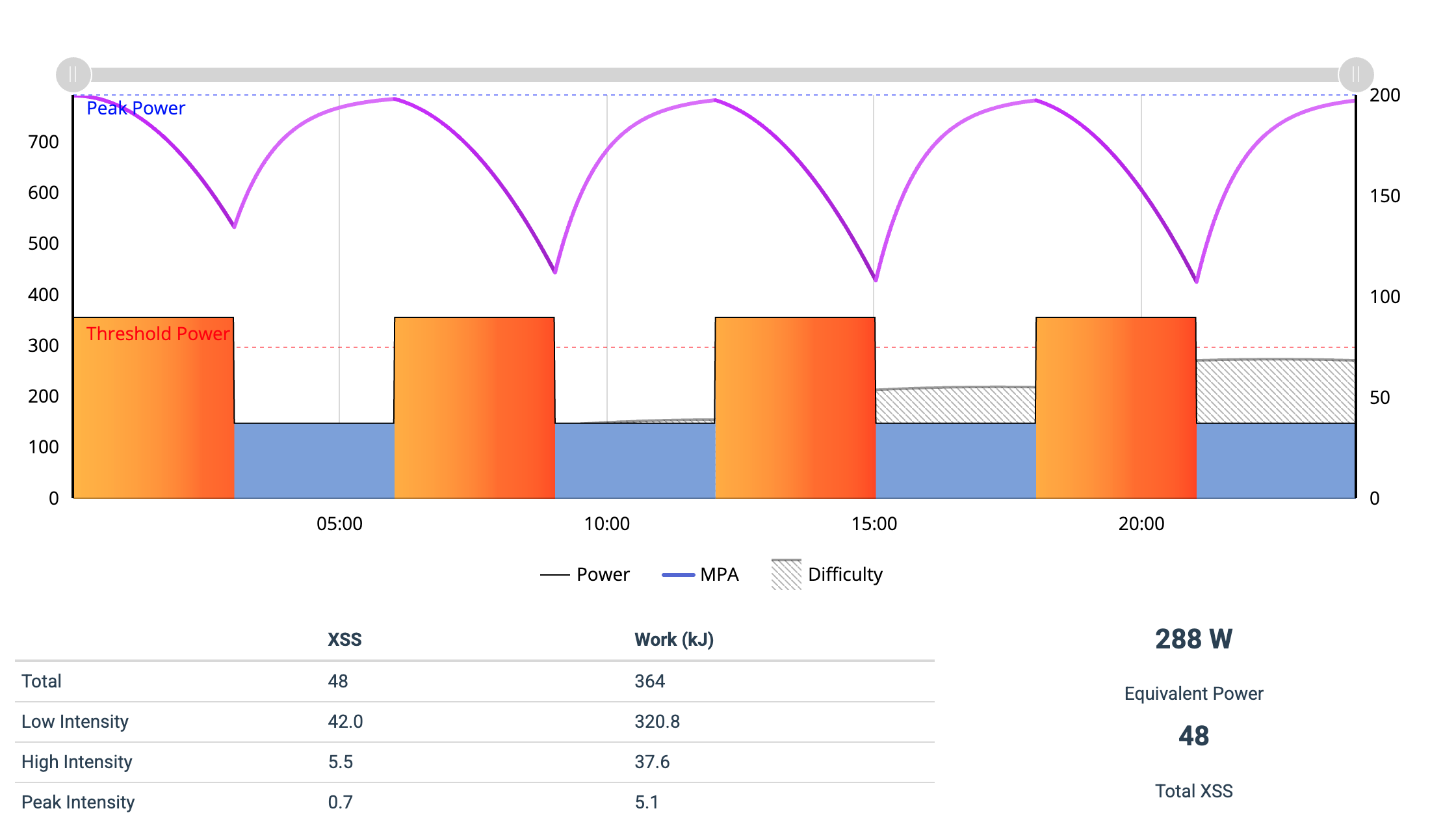
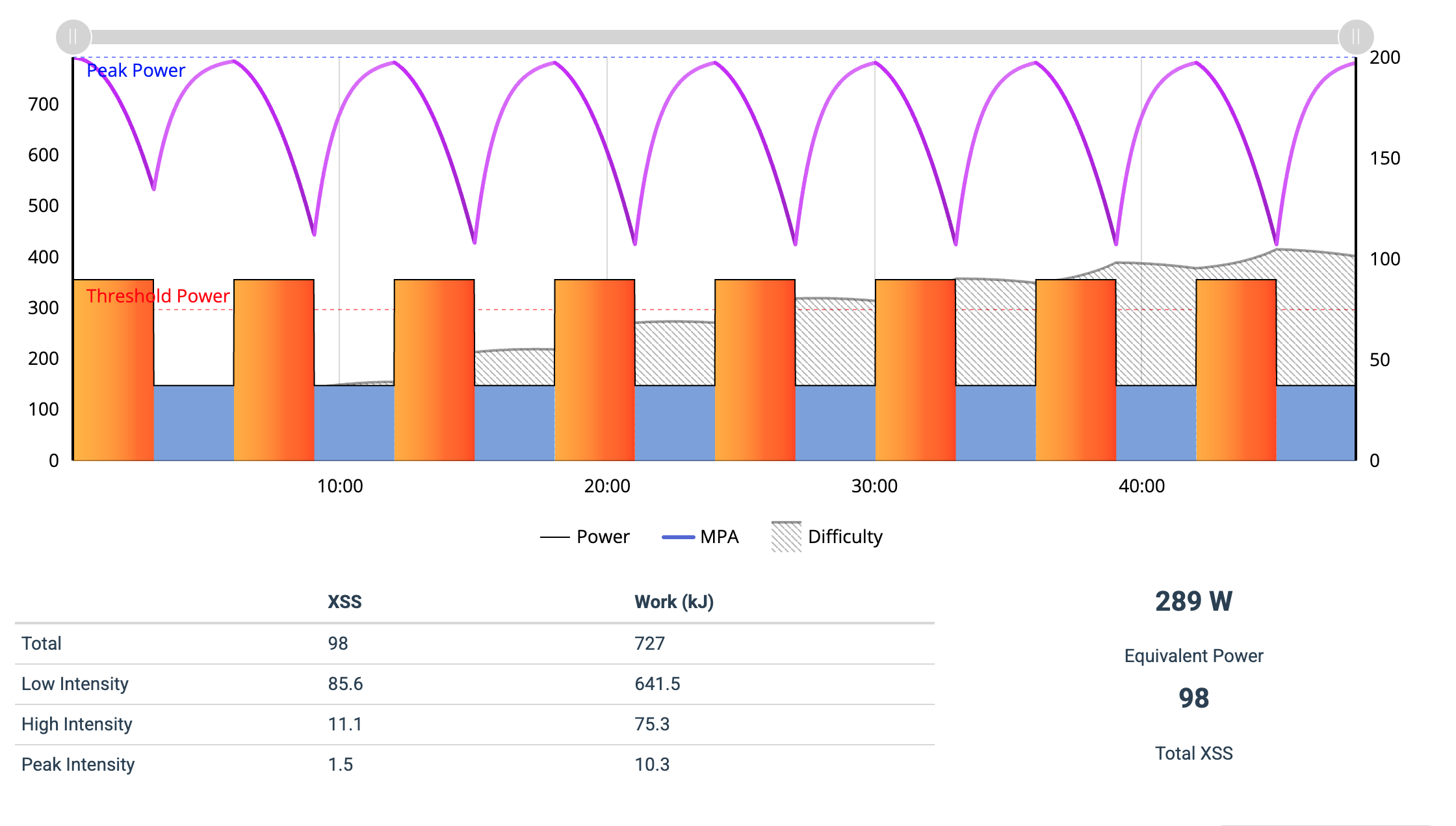
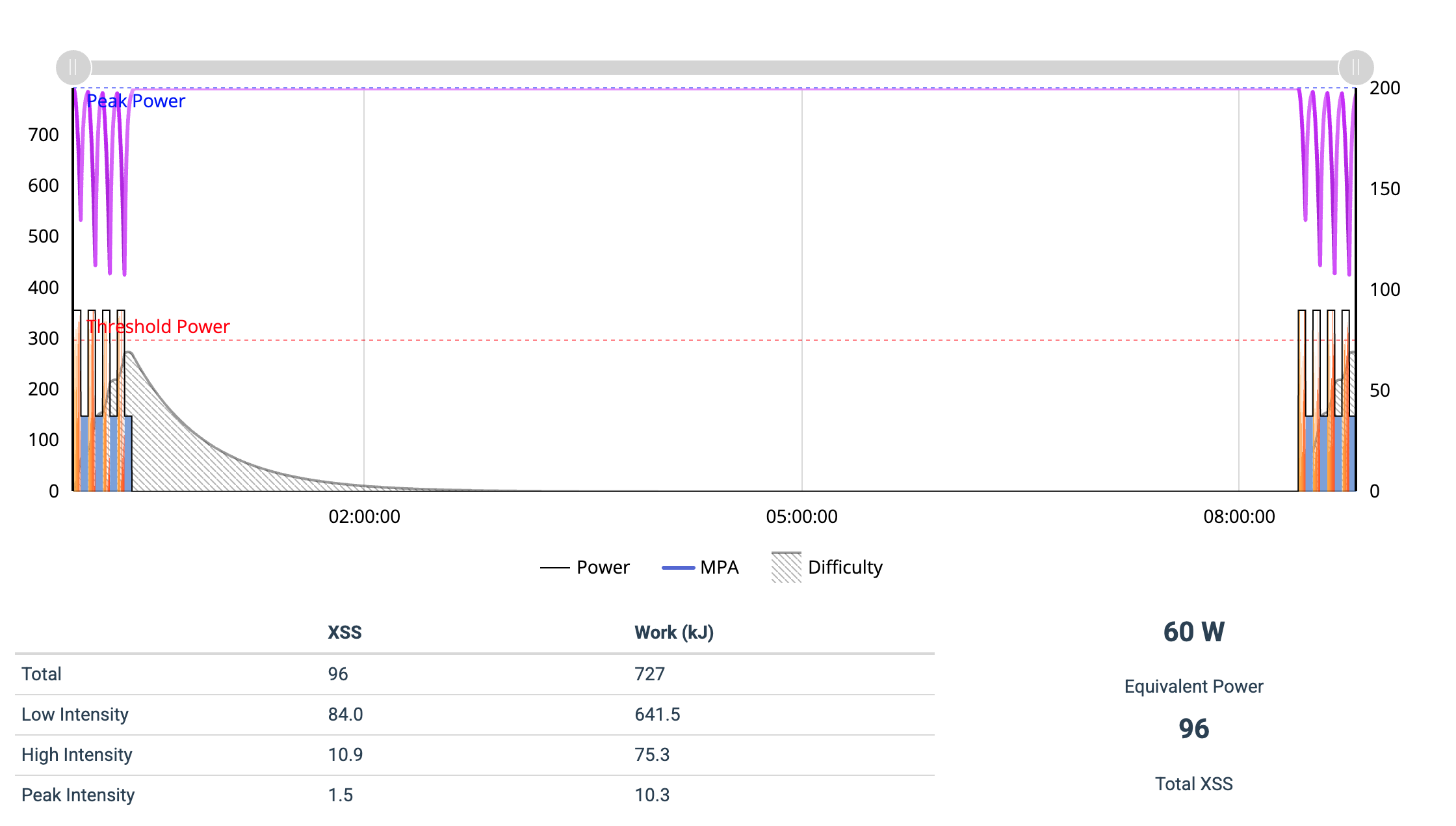
Hi, I see your point, but I believe that is only true if MPA is actually suppressed with the current Xert model. Below I have included 4x3 min VO2Max in three different ways:
a) Once
b) Twice without a separate rest between them
c) Twice with a 8 hour rest between them
As you see, the XSS produced is almost the say (assuming you do the workout in a) twice). If I however reduce the rest between the intervals I will get a higher Xlss, Xhss and Xpss because of the suppressed MPA.
1 Like
The thing that I am stuck on is the difficulty metric. Maybe it doesn’t play as big a part as I am thinking, but isn’t pushing through fatigue / tiredness / weakness what triggers the body to get stronger?
According to the Xert model the difficulty does not matter in terms of adaptions. What drives adaptions is the XSS.
It still doesn’t really make sense to me, but no matter really.