It seems like no matter what I do I’m being overprescribed high intensity training sessions.. Is the polarization based on time in zone instead of session effect or something? It’s like it thinks doing 20% hard and 80% easy in every single ride is the same as doing 20% of rides as hard workouts and the other 80% completely easy
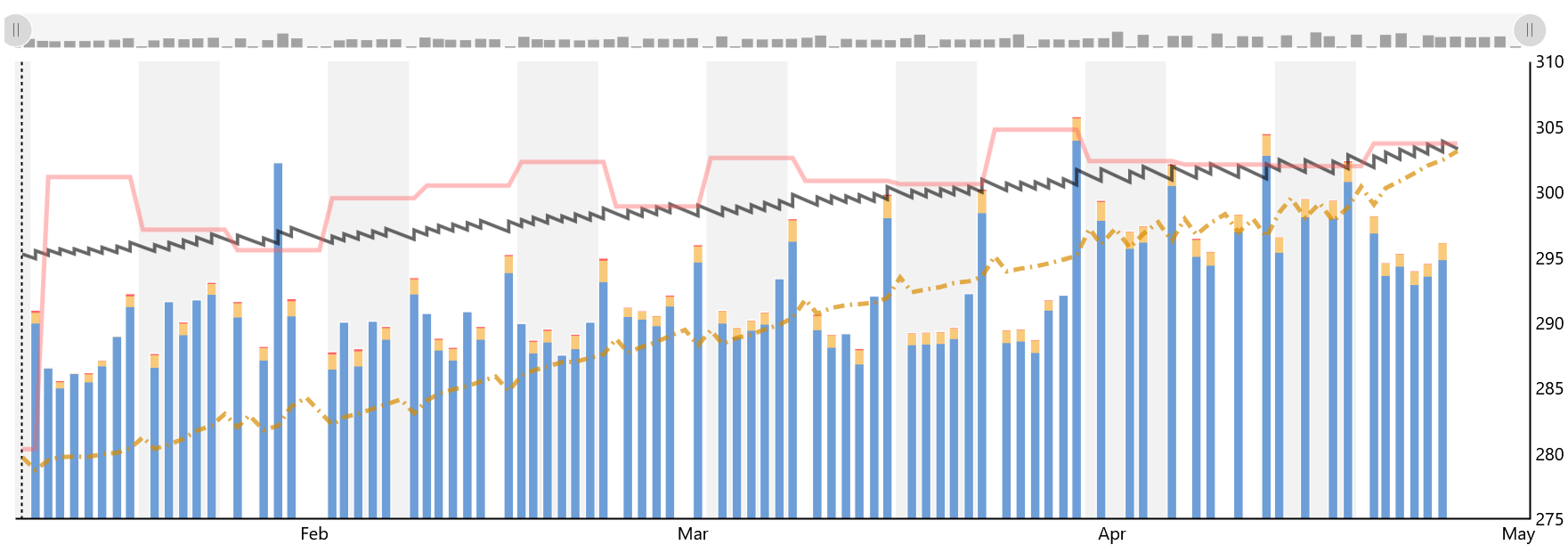
If you don’t have enough time availability to do the necessary High/Peak XSS every X days, then that load will be spread across several days such that progressive overload is achieved across all systems. This is done by several coaches who sometimes refer to this as “micro-dosing” their athletes’ intensity.
If you truly wish to only do high intensity 20% of your training sessions and if you want to make meaningful gains on your HIE/PP systems, you’re going to need to do an insane amount of High/Peak XSS on those days, since they’re trained so infrequently. Another way to think about it is that you’d need to be doing FIVE times your current High/Peak TL every high intensity session just to maintain those systems (e.g. if your High TL is 4, you’d need to do around 20 High XSS every 4 days just to maintain your high fitness, let alone achieve progressive overload that builds those systems.
Also, note that “high intensity” doesn’t necessarily mean VO2max intervals or efforts to failure each time… From your chart, it looks like many of those days have fairly small doses of High Intensity that should be relatively easy to achieve. As you become more familiar with the system, especially if you use Buckets, you’ll start to appreciate the effort required to achieve different amounts of High/Peak XSS.
Hope this helps/makes sense!
1 Like
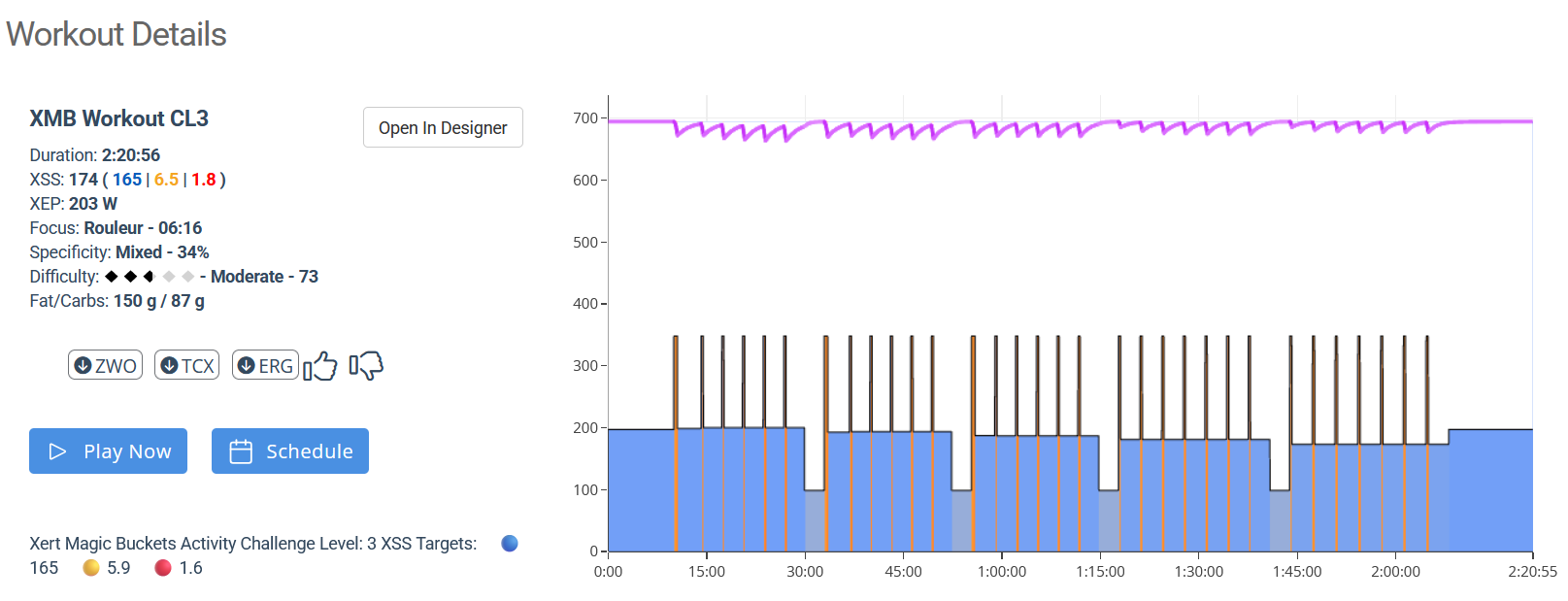
Well that brings up another problem. If I make a program to improve my 4 or 5 minute power, it wants me to do these workouts where I’m doing 20 second efforts at 135%+ power for hours. This might be the most efficient way to achieve the prescribed XSS but the actual training effect of these sessions is dubious for progressing my focus.
I’m having a hard time buying into the XSS model and XMB. The actual training effect you get from the session depends strongly on the manipulation of power and duration of effort, XMB and XSS seem to miss crucial aspect of training. It says as long as you get this specific strain score from any work it doesn’t matter how the work was performed.
1 Like
Thanks for your thoughtful post - there’s a lot of great discussion in here, and I really appreciate you sharing your perspective. Let me try to unpack a few key points and offer a different lens for consideration:
The Effectiveness of Short Intervals
You mentioned skepticism around doing short, hard efforts to build 4–5 minute power. That’s totally understandable, especially if you’re used to sustained efforts to build VO2max. But interestingly, a lot of research (e.g. Tabatas, Billat intervals, Rønnestad protocols) shows that micro-intervals can be incredibly effective for improving VO2max and 5-minute power. The ability to repeat short, high-intensity efforts with incomplete recovery builds both your HIE system and your Low/Threshold Power system - and allows for more time spent near VO2max intensities.
Structure vs. Strain (XSS)
This is a core philosophy in Xert: it’s not the workout structure itself that drives fitness - it’s the strain (XSS) you accumulate. We look at the accumulated effect of your effort across Low, High, and Peak systems, not just the duration/intensity of the intervals themselves. In other words, it’s not that 3 sets of 13 intervals of 30s hard effort, 30s easy pedaling alone is effective, but rather that structure allows a large dose of XSS to be accumulated in a relatively short amount of time. There’s nothing magical about 3x13 intervals… 3x12 (30/30) or 4x10 (30/30) would also likely be effective training!
Yes, longer intervals may build mental toughness or have specificity benefits (like learning to pace yourself), but breaking efforts into smaller chunks doesn’t dilute the training effect. In fact, it can enhance it - especially when fatigue is factored in. Xert’s strain model gives “more credit” when intervals are done under fatigue (i.e. with MPA pulled down), which is why micro-intervals aren’t just effective - they’re excellent training stimuli when applied correctly.
And don’t discount the “recovery” periods of magic bucket workouts either… they’re often at endurance or tempo intensities while you’re still fatigued, which builds great aerobic conditioning too.
The Role of Magic Buckets
It’s perfectly fine to question new tools like Magic Buckets - skepticism is normal. But you don’t have to use them if you feel they don’t work for you. You can still choose traditional structured workouts (or even import your own) - so long as they achieve the same Low, High, and Peak XSS targets, we expect the training effect on your Low/High/Peak systems will be comparable.
In fact, you could treat this as a personal challenge: stick to your preferred workout style and try to meet or exceed the signature that Forecast AI predicts over a given training block. It could be interesting to see the results!
That said, one of the big advantages we’ve seen with Magic Buckets is that athletes push themselves further when they’re not boxed into rigid interval structures. Hitting the XSS targets without fear of “failing” a workout often leads to moreeffective training in practice! I’ve heard this from many of our users and I like to hear it - moving outside your comfort zone is where fitness growth and development happens!
If you want to go the structured route, something like SMART - Closer 300 is almost a perfect match for the XSS targets you’re describing - and it gets it done in about 90 minutes (not hours). But be warned… this one looks to be brutal. I highly doubt I’d be able to complete it:
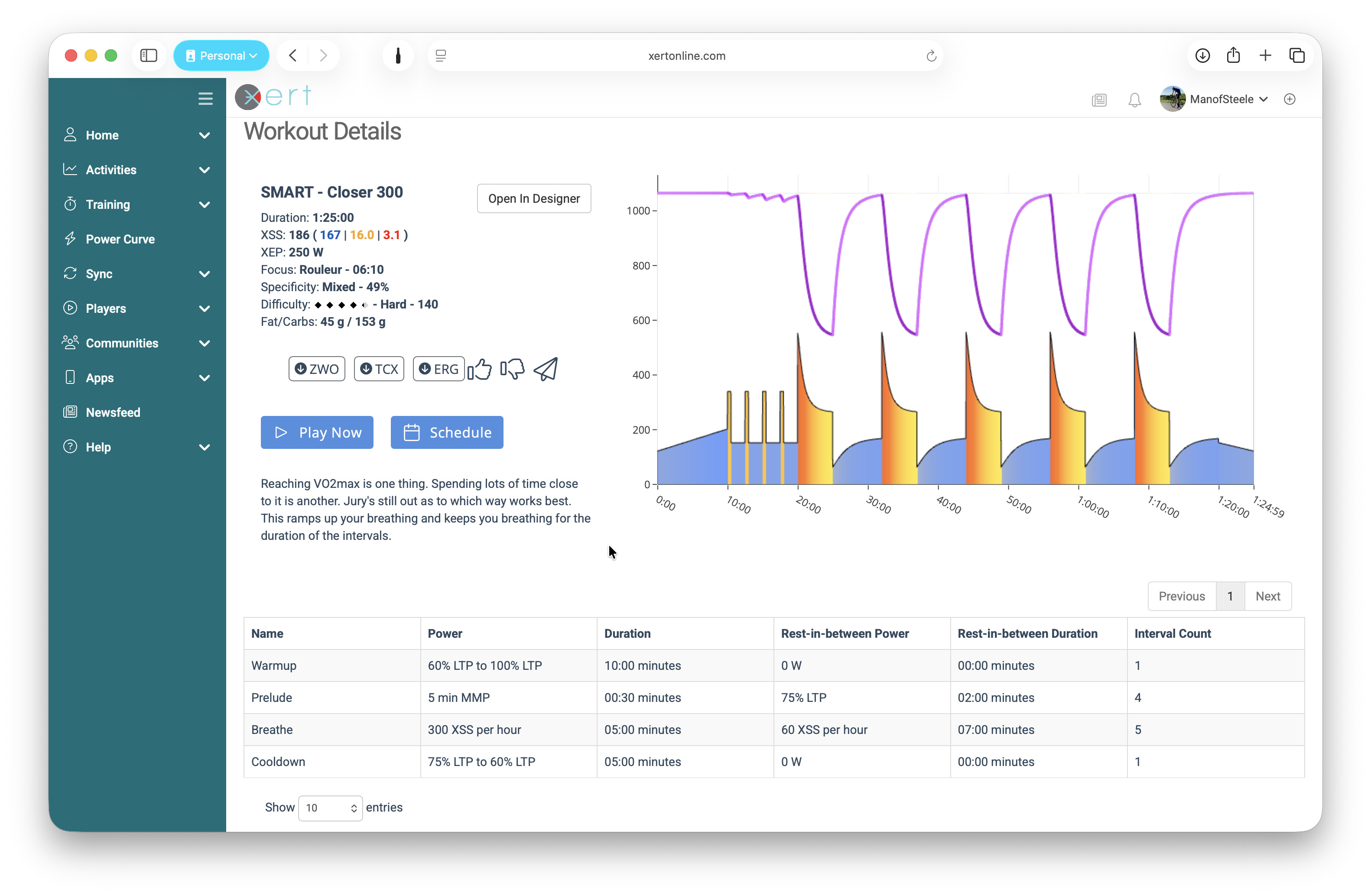
So while it’s “efficient” and a “structured” 5x5 workout on paper, the real question becomes: can it be done? And if not, is that structure really more valuable than a flexible ride where you hit those same targets, but just take a little longer?
At the end of the day, we completely agree that the manipulation of power, duration, and fatigue is critical to training adaptation - and that’s exactly what XSS and dynamic tools like Magic Buckets are designed to do on the fly! XFAI then gives increases your L/H/P targets over time to give you the Progressive Overload you need to make improvements to your fitness!
Hopefully my response is helpful & explains how we see things through the Xert lens. Thanks again for your thoughts & feedback… discussions like this are what push the platform forward & help others better understand our advanced methods! I would be curious to hear your thoughts or questions on any of this!
Cheers!
2 Likes
Thanks for detailed response, I appreciate you taking the time to write it out and the fact you’re customer facing on the forums. I can also tell you really believe in the product.
I should clarify I know short intervals build power for other effort durations, as well as aerobic endurance since the recovery is aerobic. My question is whether these are the best workouts for me to progress my focus, or the best workouts for me to hit my XSS target. I’m guessing you’d say those two things are completely aligned but that’s hard to believe without seeing any evidence.
If you throw a ton of stuff into a “magic bucket”, mix it around and make progressive overload, people will get faster. It’s very hard from that point to say their performance increase can be attributed to any specific component that was thrown into the bucket. Looking forward to the outcome of the study though.
Another long one, but I find these discussions engaging (& hopefully helpful for others who are just lurking the forum) 
This is a great question! What makes a workout or series of workouts “best”, or “better” than others?
And would your answer apply universally for all athletes wanting to build their 5 min power? If so, shouldn’t everyone follow the exact same set of optimal workouts to build their 5 min power in the most optimal/efficient way?
We would say that as long as the athlete achieved the strain needed to achieve progressive overload, then yes, they had a great session, whether they did them in an “organized” manner or not. You could accumulate the strain by doing a structured 5x5 VO2max workout (which is very efficient, but also very challenging), or by spreading out those efforts over a longer ride. They might require different total amounts of work, but generally yes, we would say they’re equivalent if the strain is equivalent.
I do want to emphasize that Buckets are not equal to Time in Zone, since XSS accounts for the effect of fatigue. For example, if you were to do 5x5 VO2max intervals, Xert will give you more “credit” for the last minute of each interval compared to the first minute because the latter is performed with significant fatigue. The same is not true of other training scores based on time in zones or average power - since they have no ability to account for fatigue as the intervals are done. To them, each minute of each interval is equivalent since they’re at the same power output.
In my (biased) opinion, our approach is actually quite simple: Do more (Low/High/Peak) XSS and your fitness (TP/HIE/PP, respectively) will improve! The smaller details might not materially matter (e.g. high intensity 2x’s per week vs. 3x’s per week, Micro versus long intervals, etc.) as long as you’re achieving progressive overload.
There isn’t really much of a black box or stressing about picking the “best” workouts. Do structured workouts if you’d like and you think they help! Or, don’t do them if you don’t like doing structured workouts.. It’s not the structure of intervals that make you faster, but actually the work of doing those workouts that makes you fitter!
The only “magic” that we do is calculate the target power that will apply XSS in equal proportions to the systems you need to train, which is what Magic Buckets does interactively as you ride
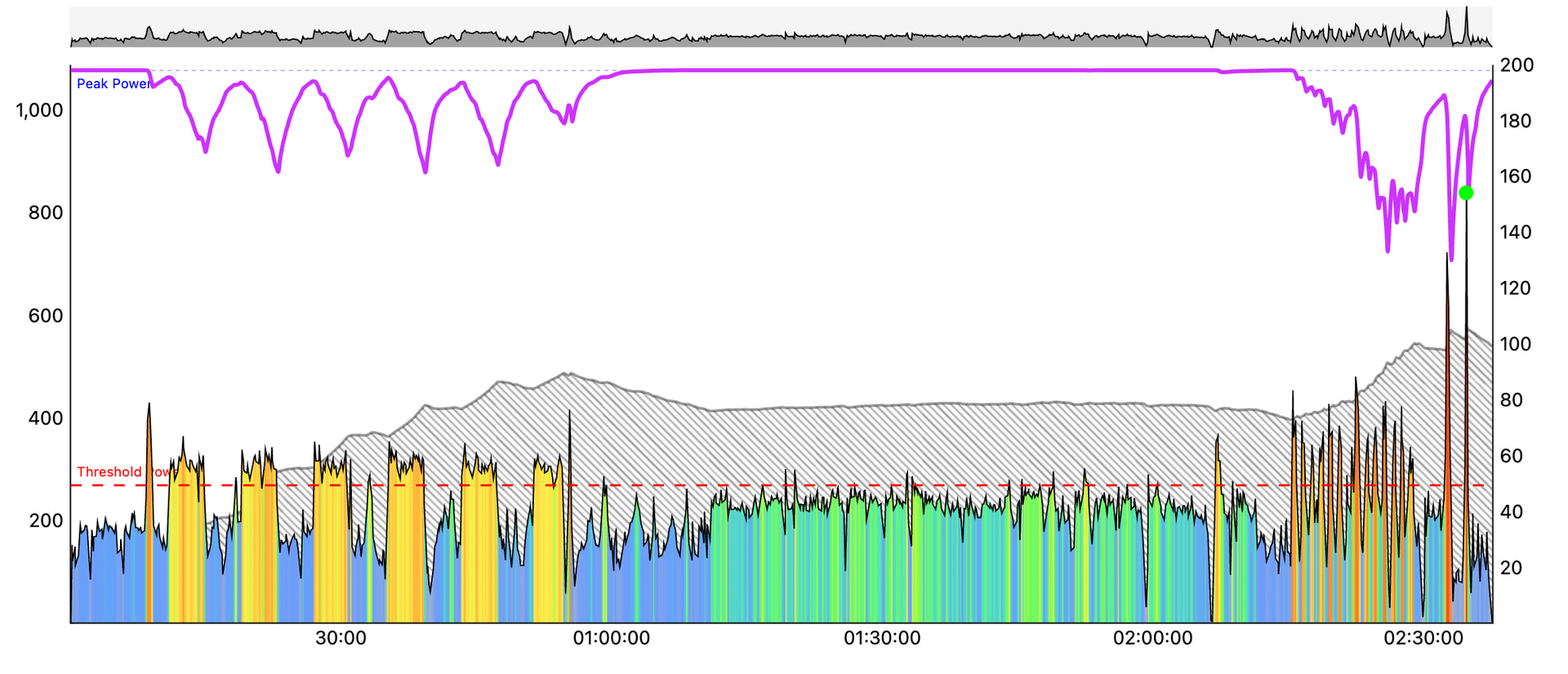
This new features is helping many athletes get the training that they need done, one way or another! If you’re skeptical, you could even combine a standard/traditional workout with Magic Buckets… do your normal workout first, then “top up” with Magic Buckets at the end. I found this a fun way to train outdoors a few times last year:
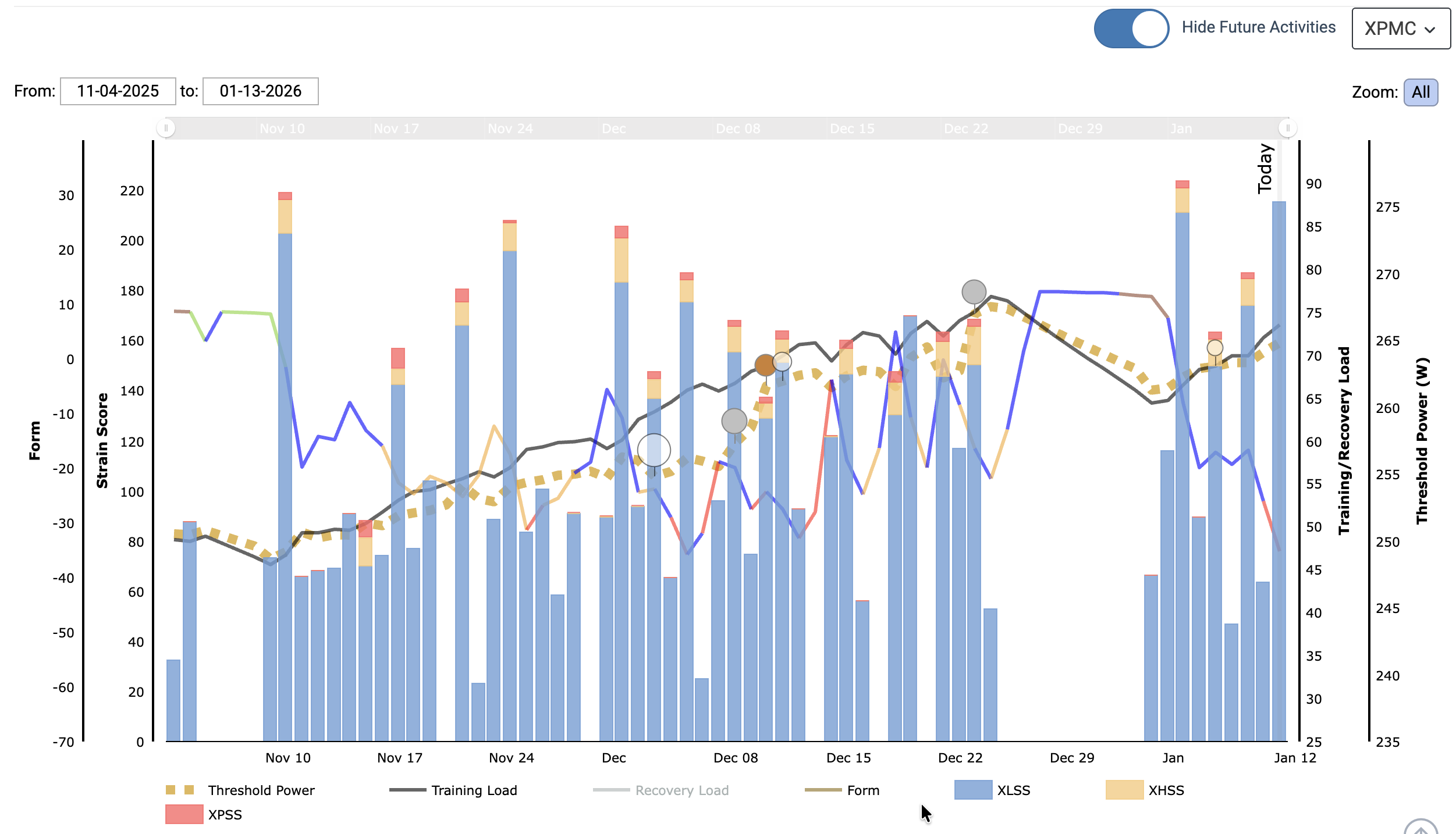
Lastly, anecdotal evidence for now (along with reported success from others), but I have had great success with my winter training so far. I’ve only done 2 structured “workouts” - the rest of my intensity so far has come from a combination of Magic Buckets & Zwift racing. I’ve already increased my Threshold by ~8% with more room to continue growing (I’m currently only at 3-star fitness- hoping to reach my 4th star in time for outdoor season):
Thanks! I’m starting my participating in the study later this week - I’m excited to contribute my data! I’m hoping it will help motivate me to finally reach my past levels of peak fitness, if possible.
If others are keen to participate, there’s still time! Details here: Participants Needed!
1 Like
Well written Scott.
This is an absolutely excellent summary of how Xert works. I always expound the view that Xert works but I cannot see how doing lots of 20-50 second bursts helps me to improve 10 minute power. But it does !!
1 Like