Lots of great discussion in this thread! I’ll think a bit on it and share some thoughts based on specific comments.
This has always seemed so obvious to me! Older training approaches are so focused on doing XYZ % FTP for exactly XYZ minutes to target a specific zone or adaptation, if you will. (FWIW, I understand the reasoning for & can appreciate the thought behind it).
But races very seldomly have such clean, distinct efforts. Races aren’t won by doing an 8 min effort at exactly 108% FTP (especially in ERG mode, haha!). There are surges, slight recoveries, etc.
In a year of (virtual) racing, I had maybe one race that had a two efforts with a near-constant power effort up a steady climb. In this race, my goal was to hold close to my Xert-predicted 6 min power for ~5 min, which worked beautifully for me:
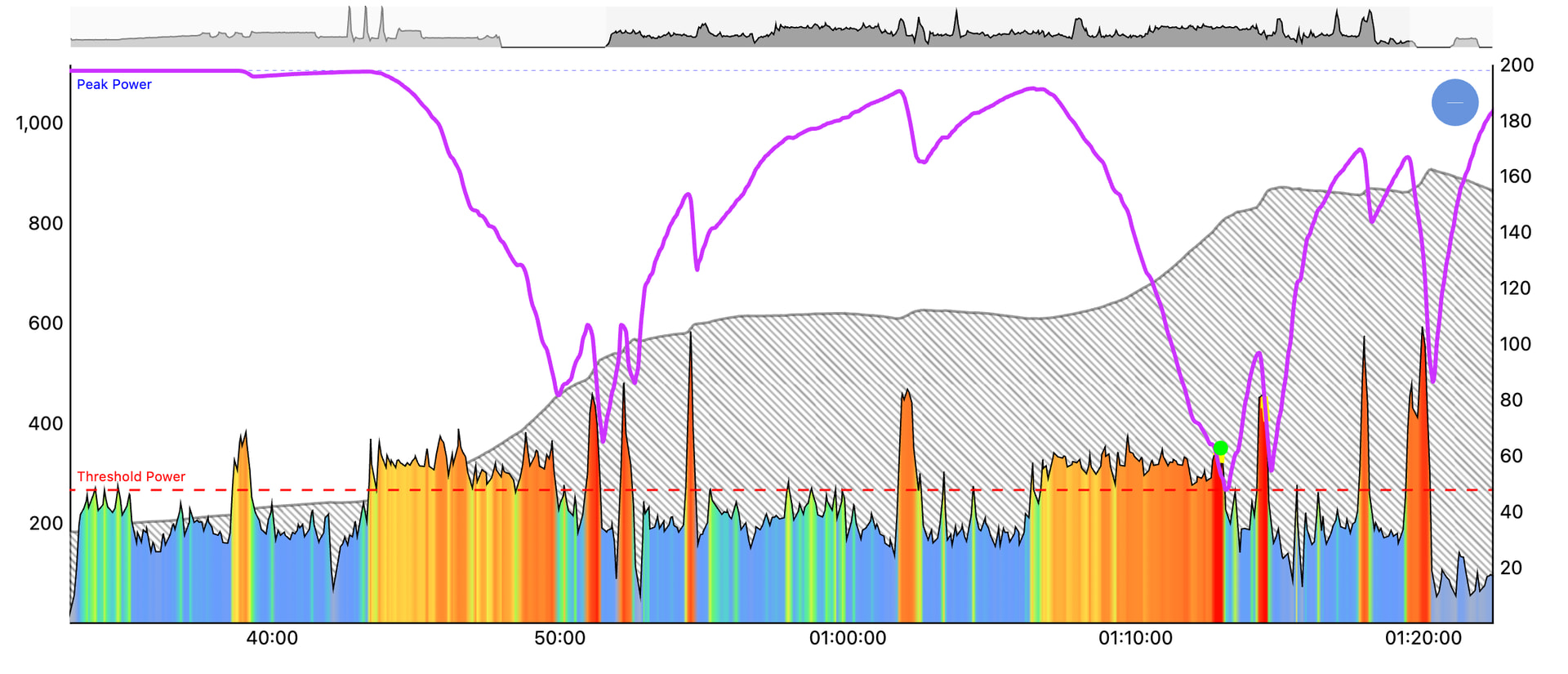
The rest had “kitchen sink” efforts with hard sprints for 30s, sustained attacks for 90+s, and often times very short recoveries near Threshold between. So to imply that you can only improve your performance by doing those clean-cut efforts seems silly to me.
Instead, the idea that you can train those systems to a similar extent without following an explicit structure completely makes sense! We’ve said this for a loooong time now: The structure of the workout doesn’t increase your fitness: physically doing the workout (e.g the strain/XSS) is what increases your fitness!
Of course following a structured workout will be beneficial (I’m not saying at all that structured workouts don’t work or are bad), but if you’re trying to increase your ability to ride hard, then also doing any hard riding will help you achieve that goal (racing will help, hard group rides will help, etc.).
Xert helps athletes with the progressive overload needed to make them stronger (across 3 dimensions of fitness) in the proportions we think are essential to their goals (e.g. ‘Focus’), all without requiring the structure that older training methods rely upon.
3 Likes
I totally get that racing is not about holding the exact power x percent of FTP - maybe some time trials need this kind of effort. But I never heard of anyone especially good amateurs or pros doing race simulations that frequently. And isn’t it what you recommend: racing in training?
Another point: for me personal it is not really about racing. Maybe I will do a race but most of the time I’m a recreational rider who still has the ambition to become faster. That is why I don’t only ride for fun but with purposeful sessions 95% of the time.
As I said I’m not a scientist but my understanding of structured (traditional) workouts and holding x amount of ftp for x minutes is, that depending on power and time in zone you get a specific stimulus on the muscles, the blood, oxygen intake etc.
AFAIK this is still how most pros train. I don’t want to compare myself to them but they surely have the best resources, sports scientists, coaches etc. - are they all wrong?
But is this theory or proven?
I don’t know where you got your knowledge about how most pros train.
For me it’s clear that whatever their training approach is will not work for me, due to a completely different situation: Having less time for training, need more regeneration, no access to labs for testing and no world-class trainer that draws the right conclusions from my performance & lab results.
The few studies I’m aware of typically compare different interval prescriptions (like Seiler’s famous 4x4, 4x8, 4x16 2013 study) and observe that one interval type works better than the others to maximize one (ore more) measured outcome variables - in this case 4x8.
But because only discrete points in the continuous spectrum of possible interval types were tested, it would be wrong to conclude that the winner is also the optimum. Maybe the optimum would have been 4x12 with slightly modified rest (if actually tested).
Unfortunately that’s not how “the internet” works. What sticks and is repeated over and over again is the simplified message “4x8 is best” - without taking the actual training subject’s training status into account.
This does not render the traditional approach wrong, but I think, blindly following fixed traditional interval structures will for most of us not be optimal either.
So, I personally see traditionally training interval structures with fixed load intervals and fixed rest between them somewhat critical.
The “time in zone” concept you mentioned is already more flexible.
If you think about it more carefully, the concept of “time in the zone” essentially disregards structure and focuses instead on the total amount of work accomplished.
That’s where Xert comes in.
The library workouts are (like all other workout libraries I’m aware of) designed to touch specific physiological systems - thus giving you “time in zone”.
Unlike the intervals used by competitors, these should be better suited for training, as they can better account for fatigue, the need for recovery, and - in particular - performance levels above TP (due to TP/HIE/PP vs. just FTP).
Admittedly, XMB is pushing the limits, so you have to ask yourself (and decide on the spot) which zone or system you actually want to work on.
To return to your latest question: No, I can’t point you to a study proving exactly this.
Anyway, you might find the following video discussing a meta-study about what top-level coaches do, interesting: https://www.youtube.com/watch?v=l2YpCa01VsU.
Also, more recently Stephen Seiler came to the conclusion “It’s about the long game, not epic workouts“:
- First, HIIT training cannot be seen in isolation. Successful endurance athletes perform most of their training volume below the first lactate turn point (<LT1), with “threshold training” and HIIT as integrated parts of a synergistic combination of training intensities and durations.
- Second, molecular signalling research reveals multiple, “overlapping” signalling pathways driving peripheral adaptations, with those pathways most sensitive to work intensity showing substantial feedback inhibition. This makes current training content and longer-term training history critical modulators of HIIT adaptive responses.
- Third, long term maximization of endurance capacity extends over years. Successful endurance athletes balance low-intensity and high-intensity, low systemic stress, and high systemic stress training sessions over time. … It is not “epic” HIIT sessions but effective integration of intensity, duration, and frequency of all training stimuli over time that drives endurance performance success.
So I guess in the future will we see more complex training models, that will take these interdependencies between individual workouts, short-term and long-term periodization into account instead of handling them in isolation.
1 Like
Yeah, lots here. I’d refer anyone to Seiler’s training pyramid which attempts to visualize the importance of different elements of training. For example, the bottom level (most important and foundational) is volume, then as you go up the pyramid the effect is thought to diminish. So, intensity distribution, specificity, etc are all there.
Specifically to the point of the thread, if you follow the Focus, Specificity, and Difficulty prescriptions from Xert, I think the progression would be very much like a structured progression. For example, if I say, “do a Pure Breakthrough workout at a 75 Difficulty”, there’s not actually very much wiggle room in that. In my experience, where it feels like there’s not a strict progression is where I let Specificity or Difficulty slide, like the load might go up week on week, but if the workouts get longer, Difficulty could plateau.
On racing as training, other platforms and coaches take a dim view of group rides or races as training, and I think it’s exactly because they can’t quantify them very well.
1 Like
One additional aspect I’m trying to understand is the complexity of the workouts themselves.
With a traditional workout such as 4×8 min or 3×12 min, I don’t have to think much while riding. I quickly get a feel for the required power and can then stay there without constantly looking at my bike computer. The same workout works indoors or outdoors.
Some of the SMART workouts I’ve seen are much more varied, with frequent changes in intensity, short preloads, hard efforts, recoveries and different targets. I can see how that might be entertaining or engaging for some riders, but that is not particularly important to me. I’m perfectly happy for a workout to be boring if the structure serves a clear physiological purpose.
This also relates to my experience with XMB outdoors. With traditional intervals, I can reach a point where I’m breathing very hard and clearly feel that I’m working near VO2max. That gives me a fairly intuitive sense that I’m producing the intended stimulus.
With XMB, I can certainly reach that feeling if I deliberately push harder, but when I follow the prescribed targets and recovery periods, I often don’t get there. The recovery periods can feel quite long relative to the hard efforts.
So I’m trying to understand the underlying logic here:
For someone whose riding is predominantly steady-state and who is primarily interested in general performance improvement rather than race-like variability, what is the physiological advantage of a highly variable SMART/XMB workout compared with a much simpler traditional interval workout targeting the same Focus and XSS?
And specifically:
-
Is the additional complexity actually intended to produce a different or more effective physiological stimulus?
-
How does Xert determine that the variable structure is an appropriate substitute for something like a longer, steady VO2max interval?
-
If I deliberately follow XMB’s prescribed recovery periods, should I expect the same VO2-related stimulus as from a traditional workout where the intervals are long enough to keep me breathing very hard?
-
Or is Xert intentionally optimizing for a different kind of stimulus that may not be obvious from how the workout feels?
I’m not looking for the most entertaining or engaging workout. I’m trying to understand whether the complexity has a meaningful physiological purpose, or whether I would be better served by using simple, traditional workouts on my hard days while letting Xert manage the overall load, recovery and progression.
That is definitely an advantage of the relatively simple structured traditional workouts.
I personally don’t care whether my indoor and outdoor workouts are the same.
May I ask why you care?
I’m guessing that you want to do your workouts outdoors or on a trainer in slope mode, because I don’t see any problem here on a trainer in ERG (auto) mode. Is my assumption correct?
That aside, it seems that two things are getting mixed up here: SMART workouts and highly variable workouts.
SMART workouts contain intervals that the workout player dynamically adapts in real-time to your previous performance in the workout. E.g. a recovery interval might get longer/shorter or demands more/less power than originally specified depending on how you hit the target of the previous load interval. This is a feature unique to Xert.
SMART workouts are not necessarily complicated (see Somebody Told Me).
Most workouts in Xert’s library are SMART and highly variable.
I don’t think there’s a general advantage.
But for the typical/intended use-case of riding on a trainer in ERG mode that’s also no disadvantage that should be avoided (from a workout-designer’s pov). Maybe that’s not your use-case.
I know of a few workouts that include 30-second/15-second intervals, which is certainly no coincidence and stems from the study by Bent Rønnestad et al. (2020): “Superior performance improvements in elite cyclists following short-interval vs effort-matched long-interval training“.
So, for them (e.g. Harder To Breathe) there is a proven advantage (for elite cyclists . . . ymmv).
Maybe @ManofSteele can shed some light on this and your specific questions.
Does your question refer to an absolute physiological advantage of the more complex workouts per se, or are you asking to weigh the potential benefit against the (im)practicality of performing these workouts outdoors or on a trainer in slope mode?
Just as a side note: The physiological impacts are not always what we expect them to be: YT: What cycling training is actually doing & study mentioned in intro.
Edit: In case you want to learn more about the 30/15 intervals and their advantages, GCN interviewed Bent Rønnestad about them.