I did a SMART - Uprising - 90 a few days ago on the Xert EBC app and a couple of things confuse me:
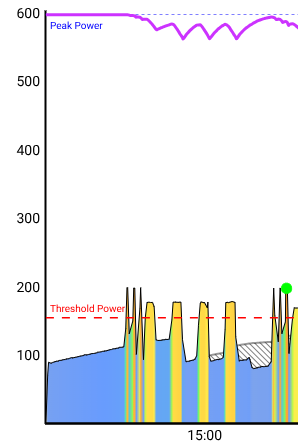
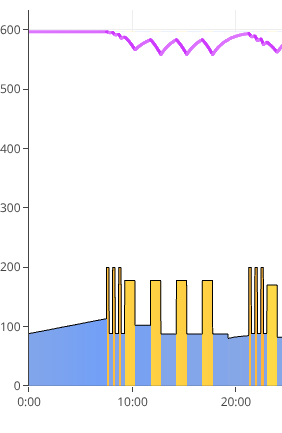
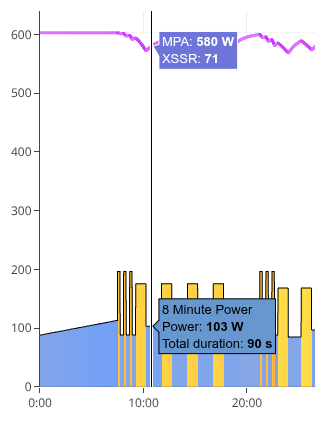
During the activity, I was looking at the workout chart and noticed that the real time MPA line (purple)) was not tracking the design (teal). It was significantly higher even though I was doing the exact power subscribed. (I didn’t take a screenshot unfortunately). But now when I look at the activity on the web app, it does seem to match the workout:
The other thing I noticed is that the recovery segments power was consistently higher than the workout perscribed, making the activity harder than I expected.
If you have a Wahoo trainer you’ll want to disable power smoothing so you can see actual wattage variations during intervals. You’re not seeing those fluctuations currently.
Do you mean while watching the Remote or Session Player online while executing the workout on EBC?
Or watching the workout chart on your phone?
SMART intervals consist of a variety of intervals not anchored on the traditional format of %FTP.
Instead of X watts for Y minutes the interval targets are strain-based per Xert’s MPA model. This allows workouts to scale to a rider’s fitness signature and power curve.
Same workout can have different %FTP target ranges for riders with different signatures but same TP.
Think of the target as a physiological state rather than strictly X watts.
One type of SMART interval is dynamic meaning the target can vary in power (or duration) dependent on execution. With dynamic power intervals you may notice the power wavering during the interval especially towards the end if the execution was consistently above or below targeted strain. Or a rest interval changes resistance based on targeted recovery status for the next work interval factoring in fatigue generated during the previous interval.
Real-time MPA monitoring ensures you reach the intended strain targets.
In your example, SMART Uprising, the work intervals are defined as X-minute MMP and the rest-in-between intervals as % Reserve MPA.
X-minute MMP: power target calculated from the athlete’s Fitness Signature and power-duration curve, representing the athlete’s modeled maximal sustainable power for that duration.
% Reserve MPA: target defined relative to the athlete’s TP-to-PP reserve, used to set a desired MPA state and, in dynamic SMART intervals, adjust power or duration to reach that state.
Xert EBC determines the wattage needed to achieve the target states in real-time. That’s why discrepancies between the planned chart and executed power are not only possible but expected during SMART workouts.
Sounds complicated but in practice you just ride the workout as best you can.
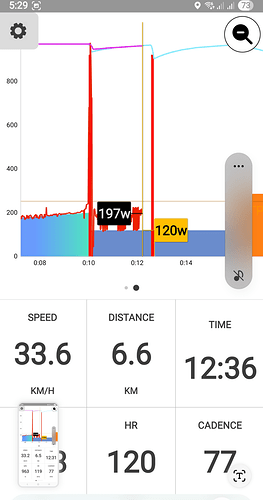
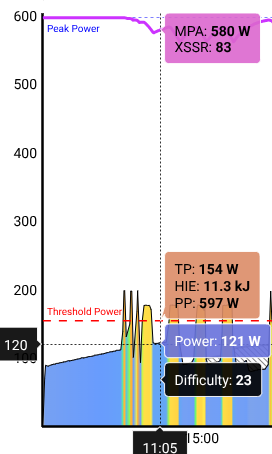
I wasn’t using the remote / session player. I was using the EBC app on Android and was looking at the top half of the screen on the second page, not the rainbow screen, the workout chart. Something like this (this is not from my workout, I found this on the web):
You can see in this screenshot, the live data (purple line) is tracking the projected data (teal). In my case, the purple line was consistently a lot higher than the teal.
The strange part is that later when I examined the recorded activity on Xert web, the actual HPA did match the projected HPA.
I suspect that was happening is that because my HPA was consistently higher higher than the projected value, Xert concluded I was too fresh and increased the power on the recovery segments.
Did you leave it on the chart page the whole time, or were you flipping between the gauges and the chart?
There’s a reported bug in the display when switching back & forth between the chart that will be resolved in the next update to the Android app. The bug is purely cosmetic/visual and doesn’t impact your workout or the actual data analysis.
Those recoveries are SMART/dynamic recoveries that use your real-time MPA to adjust the intensity of the ‘recovery’ interval up/down based on actual vs. target MPA.
Without seeing any of your data specifically, it’s most likely caused by the tiny amount of lag where it takes your trainer to get up to power for the “ON” intervals (so MPA doesn’t quite go as low as the workout calls for), which then gets offset by the slightly higher power on the ‘recovery’ intervals.