I got another question regarding a different aspect of training:
Almost all “hard days” I overshoot power in intervals and recovery. What’s labeled as a 3diamond workout before gets always flagged as 4dia afterwards. But that does neither mean I cannot finish the workout, nor do I get breakthroughs there - since my goal was to do intervals, not get BT But since it’s not altering my Fitness Signature, that again means the next workout will likely be too easy again…
So: Should I stick to the power on my headunit or should I go by feeling?
Part of the question stems from an imperfect understanding on how the intervals are prescribed - I hardly get intervals above 3minutes, so I figure that also means going harder rather than easier. In classical FTP models power always way above threshold, more like VO2-zone, although not long enough to get HR that high… Also with the MPA chart being orange/red in the intervals it signals me to “go hard”, too.
So that confuses me a bit and I dont know if “easier” intervals is a deliberate thing or an error in my understanding/execution of training
EDIT: I sure would be able to switch workouts manually every time, but quite frankly: one part of why I pay for is the convenience to not have to do that.
Thanks and cheers from germany
Daniel
As an example:
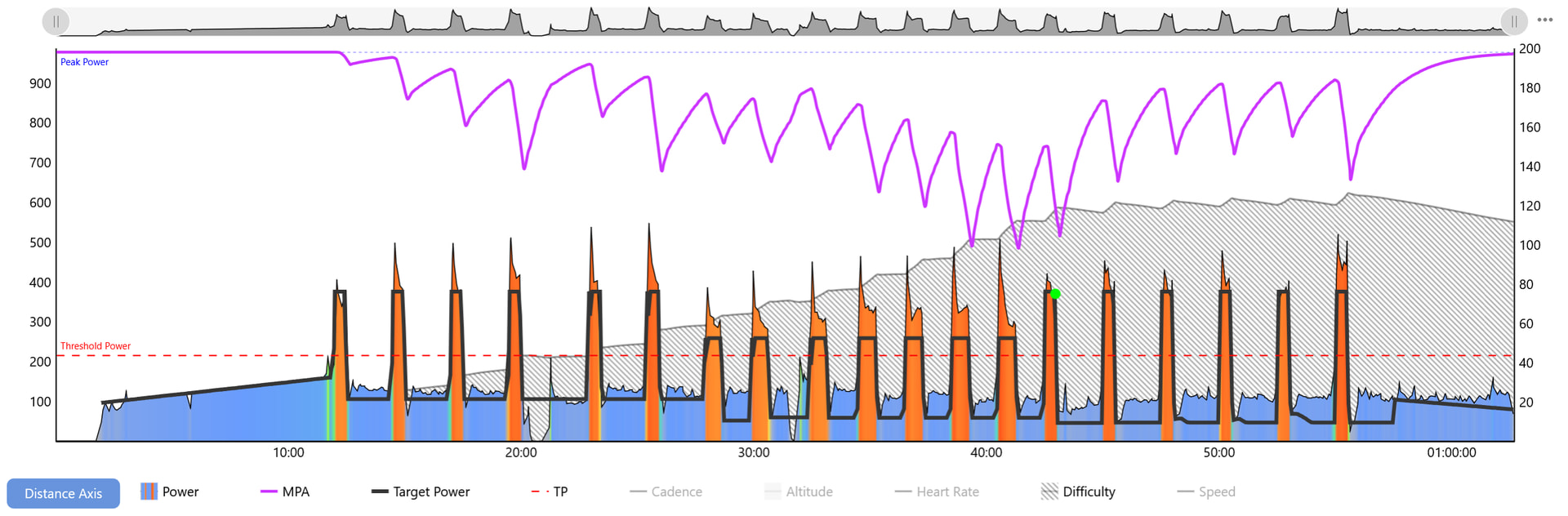
Born to greatness
should be: 3dia, XSS Breakdown 87 ( 72 | 12.0 | 2.7 )
did it as: 4dia, XSS: 128 ( 99 | 22.3 | 6.6 )
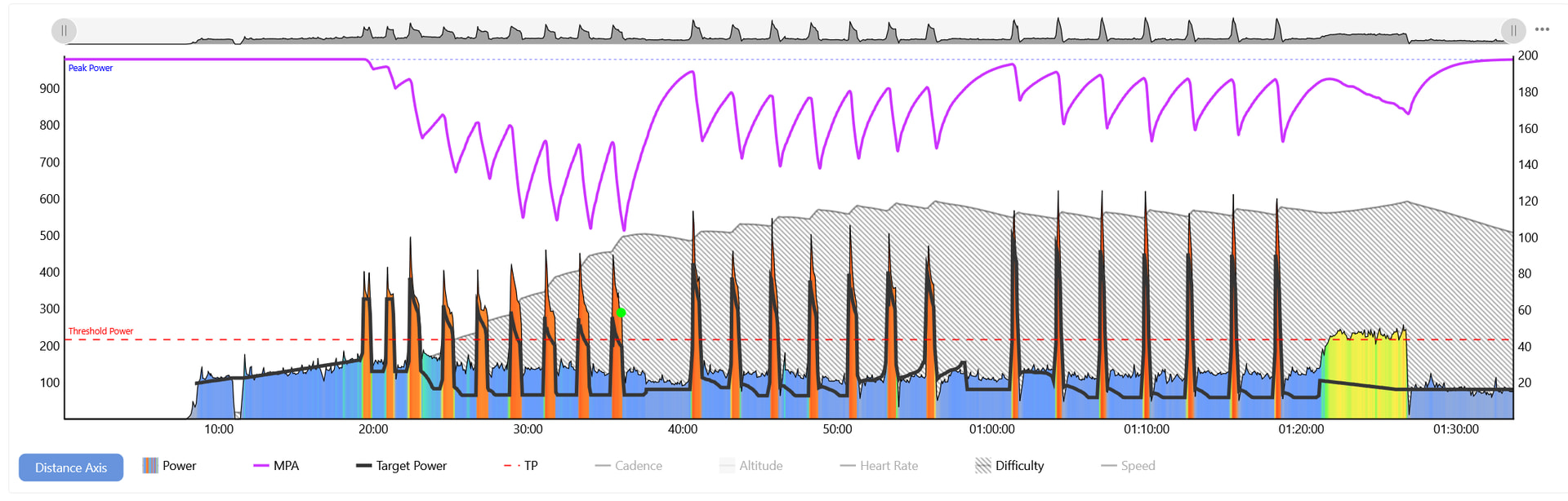
Today I had a hard day with “One Step Closer”. I didnt feel strong this morning, because I slept in and was on the bike within 30min without properly hydrating or eating. Also I had to stop the workout 15min early, too, because I had to get ready for work (sleeping in-tax ).
So I skipped 4 intervals, but I’m not sure if I even wouldve been able to finish them anyway. Or I would at least have had to straight out puke afterwards). Nevertheless out of guilt I decided to still “reset” at least my decayed PeakPower and did just smash it in the last interval just as high as I could go:
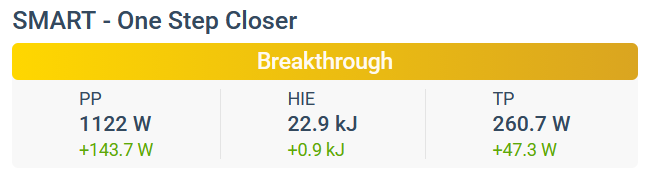
Well … I didnt even go as hard as I usually go, but wouldnt have been able anyway. Secondly I only tried to reach PP and I felt like shit and still XERT thinks my TP jumped by 50W? Thirdly I’m fairly certain I could not hold 260W for 40-70min let alone 30. Maybe 20min TT(complete)E, but even that I dont feel confident in. RPE and watts today seemed reasonable, so I do not think it’s a technical (=calibration) issue, either.
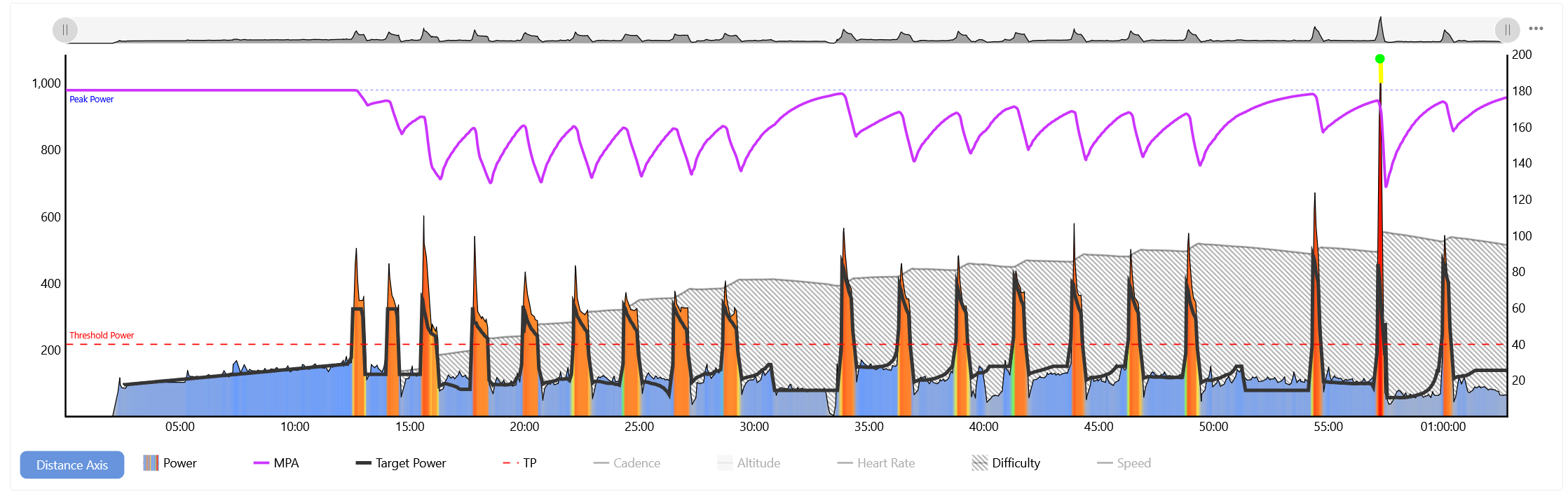
Further: 14d ago I did One Step Closer, too. Not only did I complete it, I was pushing slightly higher watts throughout and got more TSS for the same part of the workout - but got no kind of BT though
2weeks ago (I even added 5min slightly above TP at the end):
Peak power efforts with an abrupt stop is known to overestimate TP. If you know the new TP value is out of reach I would flag the activity and then manually adjust the PP if thats a true value. Click on Extract and Save if the new signature seems reasonable.
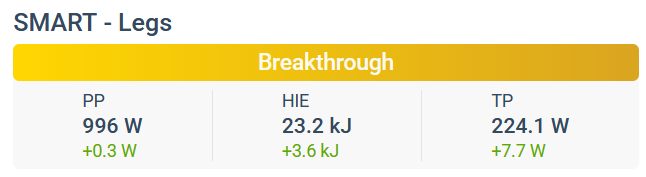
So I flagged the ride, but did a race today and while I got all time highs for 1min and 5min power I got a gold breakthrough again - setting FTP to almost the same as with the PP spike before
My original question still stands: for MPA style training and to get the best „gains“ - is it better to stick to prescribed power or go harder if you can?
As @elcomp mentions you should flag an activity whenever you don’t agree with the BT adjustment. Flagging retains the analysis but skips signature extraction.
You can view your before and after BT charts (before flagging) by selecting the Previous/Current button below the chart.
Your signature is based both on actual performance metrics (MMP sampling) and your theoretical performance (extrapolated by the algorithm).
There is a relationship between all three signature values.
If your PP was off, then so too was some portion of the curve from that point downwards.
A rebalancing occurs with a BT extraction which will raise or lower a value depending on the type of activity and nature of the BT. If the results are unexpected use the flag function.
BT’s can occur along any portion of your curve. Typically, this is when MPA has been drawn down and you express a maximal effort under fatigue. A PP effort OTOH is a short punch through your current ceiling. A signature reset is required to realign the numbers.
In addition to BT based signature changes you can also manually adjust your signature when needed. E.g. you know your PP was too low, but you feel TP was in the right ballpark.
Flag the activity to remove the BT adjustment, bump PP to a value you’re comfortable with, save that change, and more forward from there.
You can use the Extract option when the activity includes a BT event.
Extract recalculates the numbers before saving.
Refresh lets you tweak a signature, view how the change affects the chart, then Save to establish a new reference point.
Regardless how signature values are set, adjustments moving forward are based upon TL changes, decay, and subsequent BT detections.
No need for standard tests but you do want to express maximal efforts now and then including short sprints if you aren’t already incorporating sprint workouts into your training.
I suggest you leave the latest signature update in place and see how that affects your future HIT days.
Your question implies you are riding a workout in Slope mode indoors or outdoors without the limitation of ERG control.
When your signature is dialed hard interval workouts will be hard enough on their own. It’s unlikely you can exceed them consistently unless your signature is understated. If so, a BT adjustment will resolve that.
Note that XSS is not TSS and TP is not FTP.
The metrics serve a similar purpose but are not derived or calculated in the same fashion.
As far as following an Xert training plan, the daily XSS goal is a ratio of low/high/peak strain conducive to HIT or LIT workout with prescribed LIT or Rest dependent on low/high/peak recovery load.
What Program type are you using? (XATA or XFAI)
On XATA if you are able to consistently exceed daily XSS goals – and recover from the added stress – you can raise the Improvement rate accordingly.
On XFAI exceeding targets will trigger an Adapt Forecast warning to rebalance the plan. If consistently overshooting (and recovering) you should raise the goal and update the forecast or cast a new one instead.
First of all: My question stemmed from a physiological perspective/interest. I thought maybe workouts shouldnt be too hard, to get the stimulus. What threw me off was that a prescribed 3* workout resulted in a 4* session (so I thought “maybe I did go too hard”). Since training with MPA is a vastly different approach I didnt rule out that workouts could be physiological stimulating without being too hard
That being said: Flagging was suggested because I didnt think the BT was valid, at least the TP part of it. So I did, but todays BT got me almost the same bump in TP again, so maybe I really do underestimate my capabilities As a direct consequence it would be reasonable to assume, that me being overshooting targets was indeed a result of - and you said exactly that - understated signature. On the other hand I’m still a little bit in doubt if this TP really mirrors my fitness, but I guess I just - again just as you suggested - try the next workouts with the updated signature and see how far I’ll get.
Regarding program: I’m on XATA, so there’s no forecast to adapt fortunately. But another question popped up with your explanations: when changing IR in XATA I didnt really get different (as in higher XSS) workouts, it just says I need more hours/week. So increasing IR wouldnt really help if I do not have more time? I would have just overshoot XSS for 1-2 weeks and XATA should recalibrate with the rolling 7d window, right? EDIT: with the higher wattage, the same workout will automatically result in higher XSS, not me overshooting it - result is the same, but just wanted to correct that logical error
If you don’t have more time you’ll need to get more XSS in the same time I.e. increase intensity. That said, if you’ve been using a signature that is too low, your recent XSS will be overstated since it’s a relative metric, not absolute. It also means that with the new signature, it will be harder to get the same XSS per ride. I’d be careful increasing IR at the same time as having a decent jump in your signature…
 But since it’s not altering my Fitness Signature, that again means the next workout will likely be too easy again…
 ).
).