Curious to hear your thoughts — especially from the Xert team — does Forecast AI do a better job managing load and recovery than the Continuous Adaptive Program?
A bit of context: I came to Xert from TrainerRoad, where my legs were always fried — classic muscular fatigue — but I actually slept great. On Xert, it’s been the opposite. Using the Continuous Adaptive Program (Moderate-1, 6-minute focus), my legs feel fine, but I’ve been spending most weeks in yellow or red, with only one or two blue days. My sleep has gone downhill (waking up at 3–4 a.m.), and after listening to the Xert podcast on overreaching, I realized I might be overdoing it, just in a different way — maybe more systemic stress from higher volume, even though intensity feels lower.
Now that I switched to Forecast AI, I’m seeing more variation week to week — some lighter weeks, more recovery days — and it feels like it’s better at helping me absorb the work instead of digging a hole.
Would love to hear what others are seeing — is Forecast AI helping you stay fresher and manage recovery better than Continuous Adaptive?
Stats: TP 255 | HIE 23.9 | PP 1181 | Age 40 | Training ~1 year | Goal = just to get faster and build endurance, not racing to win. I know it is broad but I’ve been focusing on roleur as I think it gives me an edge on punchy group rides
Bonjour,
Content de lire tout cela je me sens moins seul, je me retrouve dans la même situation que vous en tout point pour le sommeil et s’est bien depuis que j’utilise Xert
J’étais également sur TrainerRoad (TR) où je faisais du seuil et la fatigue me faisait bien dormir, or avec Xert j’explore des puissances que TR ne travaillait pas, est-ce une phase d’adaptation?
Ce que je ne comprends pas aussi, pourquoi Xert me fait faire autant de séances pendant la semaine de compétition, je crains de perdre mon influe nerveux pour la course du 23 novembre…
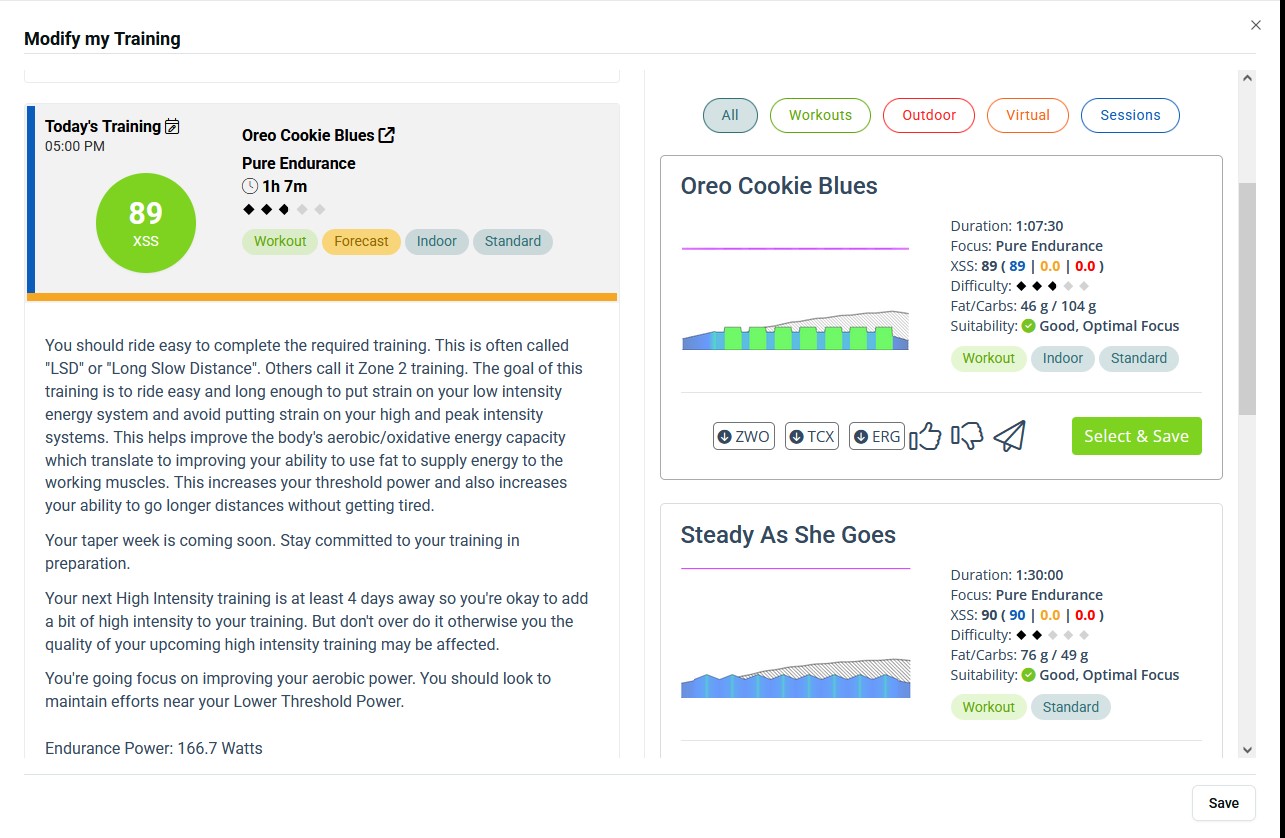
Également la proposition du jour (Oreo) me semble pas cohérente avec le descriptif du jour, je me perds un peu avec Xert pour cette compétition à venir du 23 novembre, si quelqu’un peut m’expliquer pourquoi forecast AI me propose cela je serai très heureux
Interesting that you were given not one, but two workouts that pushed you right to your limits in just a short ~5.8 hr week! But perhaps that might be okay if you are taking complete rest days afterwards (or perhaps your signature was underestimated?).
One thing I thought I would ask - are you following the auto-selected Workout of the Day? It’s totally okay if you are. The auto-schedule WOTD feature will pick one of the top 4 recommended workouts each day as the WOTD. For endurance days, I’ve found that system might tend to pick “higher intensity” endurance workouts (like tempo or sweet spot), since they’re more time-efficient. If you’d prefer not to do those types of workouts, you can give them a Thumbs down and they’ll be far less likely to be recommended or scheduled for you. For myself, I prefer to simply free ride on my endurance days (indoors or out) at a relatively easier intensity (call it sub-LTP, “Zone 2” or whatever) until I accumulate the recommended XSS (our Magic Buckets data field has made this much easier to do on the fly). This means the low intensity training might take a bit longer, but in my experience, I have found that it makes the training a bit more sustainable from a day-to-day perspective.
I notice that you’re around 2.5 star status. Another anecdotal point I wanted to add in is that I’ve historically found that my ability to recover was also a function of my training load/training status. I found that I generally recovered better (and felt stronger longer into rides) when my training load was at least 3 stars or higher. Makes sense… more training load = greater durability
Of course to get to higher training status, you’ll need to train more! And often the best way to do that in a sustainable way is through additional low intensity volume/riding, since that generally requires less recovery than high intensity training.
Xert often includes much higher intensities than you’ll see in other software platforms since we don’t assign training only by FTP. %FTP often scales very poorly at high power efforts, so most other platforms simply avoid this type of training. However, since Xert uses 3 aspects of your fitness signature, we can assign high power efforts with high precision & better prepare you for those types of efforts in your races & riding!
Just to provide some insight into why the system is behaving as it is… Your race is estimated to be ~93 XSS, which isn’t much more than your current training load (~65 if you’re 2.25 star status). If it’s comparable to what you usually do, then you don’t really need a huge taper. In Xert’s eyes, that race is actually quite similar to a typical day of training. You should be able to handle a few days of ~1 hr endurance rides the couple days before your race without feeling exhausted at the start line. Your last high intensity for the week is on the Tuesday, giving you 4 days to recover before your event. You might consider picking one of the ‘Opener’ workouts on the day before your race to prime the legs - those shouldn’t be too taxing either
If your race was going to be several times your current training load (like 150+ XSS), then you’d see a larger taper.
Regarding the potential disconnect between the auto-selected Workout of the Day (WOTD) and the Training Advice section, please see my related comment to Sebastian in this thread:
Thanks @ManofSteele for the reply.
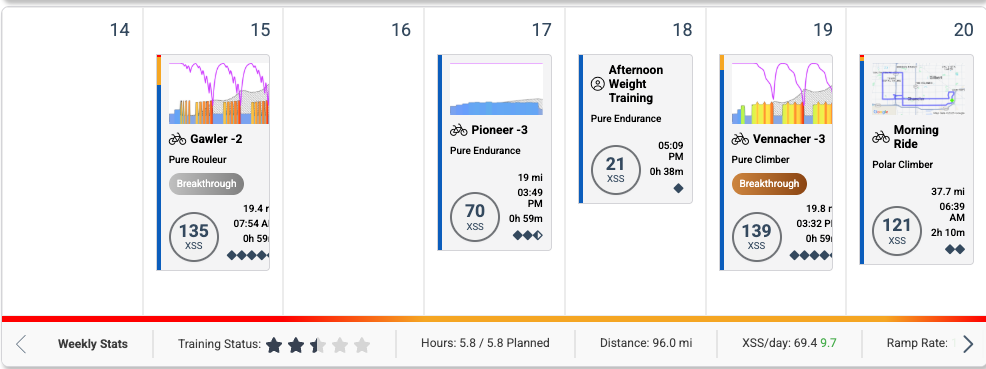
On the ~5.8h week that was TrainerRoad. It put me too my knees every week. I was extremely difficult. Every interval session I could barely finish, I had 5 to 10 secs left in my on the last interval of the session at all out effort.
It was mainly hard on my legs, I could barely walk after each of the sessions, but I could sleep well.
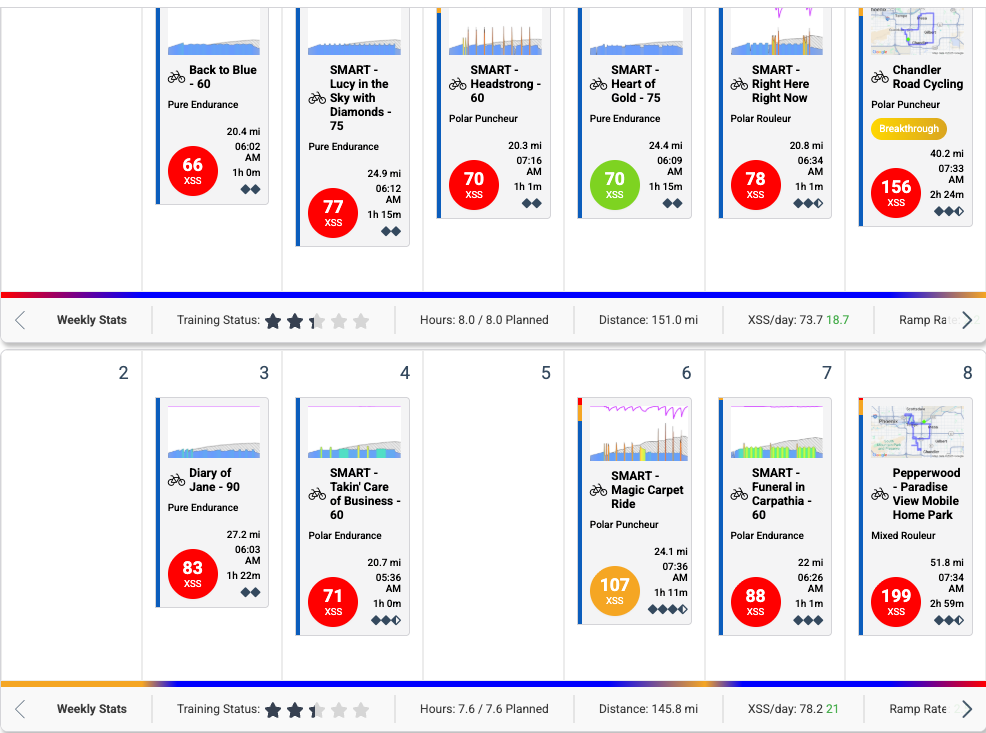
The other screenshot is Xert on continuous adaptive. I had been following the recommended work and a moderate 1 ramp rate. It has been a lot more volume than TR but much lower intensity. I haven’t had a session that has been even close as hard as TR, most of the sessions have felt easy. It just have been back to back and It seems like my body is not taking that so well.
I’ve struggled staying sleep, which I know it happens to me when I overreach. I am only about 14 months into cycling, I used to do quite a bit of weight lifting and when I overreach it felt exactly the same.
My main question was if Forecast AI is better at managing training load compare to Continuous adaptive? It felt like the Contiuous adaptive just keeps adding volume overtime without given a chance to the body to absorb the adaptations. Maybe is all in my head
In TR, I would get hammer for 3 weeks, usually the last day or two I would reach out my limits and then I would get a deload week. Refresh and do it all over again. Playing with forecast ai it seems to play with the weekly hours and it doesn’t generate a linear load increase but instead seems to oscillate so I was wondering if you guys have notice that it handler load and recovery better
I just hobbled this together so it’s subject to corrections
Program Type
Calendar
Periodized
Phased
Ramp Rate
Adjust Periodization Level
Adjust Polarization Level
Adjust Recovery Demands
Adjust XSS/hour*
Adjust Freshness Feedback
XATA Continuous
Blank
DIY
DIY
DIY
No; DIY
Yes
Yes
DIY
Yes
XATA Base-Build-Peak
Blank
Yes
Yes
DIY
No; based on setup
Yes
Yes
DIY
Yes
XFAI Goal/Event/Race
Forecast: LIT/HIT/Rest
Yes
Yes
Variable (programmatic)
Yes
Yes
Yes
Yes
No; DIY
*Raises or lowers high/peak strain on HIT days; i.e. more efficient with higher difficulty level or less efficient with lower difficulty. RD slider is most effective with shorter Focus Duration targets.
All program options support daily selection of workout activities, or you can ignore the day’s advice on occassion and do something else. Xert will adapt to whatever you decide to do. For example, skip a day, ride more/less than target, impromptu group ride, schedule conflict, etc.
All program types can be re-configured at any time. XFAI plans can be updated (recast) with new settings.
Both program types can be configured to automatically schedule a WOTD (workout of the day) on the Planner. As @manofsteele mentions this option randomly selects from top list of suitable entries based on the day’s target. You can over-ride that selection if you prefer by selecting an alternate at the last minute.
Both program types rely on calculated form to determine whether LIT, HIT or Rest is recommended.
XATA is more flexible especially if your schedule isn’t restricted. You’re in charge of managing ramp rate and Focus Duration.
XFAI is much more nuanced with a mapped out course to follow with a variable ramp rate applied during the periodized forecast.
Both types are subject to change based on your execution and any hiccups encountered along the way.
Both programs operate with progressive overload as long as your setup supports it. Confirm the deltas in Table Views for both signature and TL. An increase in TL over time is ideal. While you can continue to improve when your max hours top out, more time to train provides greater potential gain.
XATA Continuous is especially DIY-centric. You decide where to go, when to alter ramp rate, end a block of training, change Focus Duration, insert a recovery week, follow a preferred protocol (ex. polarized vs sweet spot), etc.
If you set an Improvement Rate and don’t manage it over time TL will continuously ramp up. The idea isn’t to follow the advice blindly but work with it. You want to exercise restraint and follow your gut if adequate recovery isn’t happening. If it feels like you’re digging a hole, you are. Back off as needed (lower ramp rate, make prudent selections or temporarily adjust Freshness Feedback) and resume to “normal” when ready. If consistently feeling stretched adjust Recovery Demands or take a recovery week. Be prepared to advise the advisor. You know yourself better than any algorithm does.
XATA Base-Build-Peak adds phased periodized logic running in background. But remember you’re still in control.
Xert will always recommend something each day, but you don’t have to ride each day. If you feel the need for a day off, take one! XATA will also learn over time if you take particular days off (or ride longer on particular days) and incorporate that into the training recommendations.
Continuous Improvement will always push you to do more. How much more depends on your improvement rate. If your improvement rate is generally quite low, you might find you can follow it consistently without really needing a de-load/recovery week. However, if you feel the need for a recovery week, simply reduce your Improvement Rate for a week (try Maintenance for a week). You’ll still be recommended intensity when your training status is fresh, but the overall volume of training (in terms of XSS) will be less for the week. When you’re ready to pick back up on your training, dial up your Improvement Rate.
My anecdotal evidence is that building up from lower training loads (~2 star) up to 3-4 star training loads that a Moderate-2 to Aggressive-1 Improvement Rate was pretty sustainable for me, and I would take an easier week if/when needed.
Don’t think of xert as a coach, but as a tool for progressive overload. It is more about showing what you do, less about making decisions for you. Deloading is nothing xert will suggest for you.
For me, whenever I reach an all time highest Training Load for two or three weeks, I have to take a week of recovery/adaption telling myself: “your body is not used to that, give it time to adapt.”
No, there’s no Freshness Feedback (FF) in XFAI plans… correct. It’s come up in other threads, but here’s a quick summary for clarity:
XFAI doesn’t adapt based on how you feel day-to-day. Instead, it forecasts the training we believe is needed to achieve a specific readiness level or fitness signature - based on your unique training history and how you’ve responded to L/H/P strain in the past.
Subjective feedback or readiness tools can be helpful for guiding today’s workout, but they can’t reliably be used to predict future readiness. That’s why XFAI focuses on modeling your future Low, High, and Peak training loads based on planned XSS, and maps out your training accordingly - all within your available time, not scheduling high intensity when you’re yellow status, etc.
Of course, you can still adjust on the fly using your own readiness cues. Skip, swap, or override a session and adapt your plan afterward. But if you’re doing that frequently, you’re essentially back to using XATA, which is designed to adapt training day-to-day based on how you’re feeling, your recent strain, and your goals.
I changed back to XATA just after my reply above thinking XFAI was just broken (at least for me). I thought XFAI still adapted day-to-day just like XATA but just helped better plan the path to a better defined Goal or Event. I really just thought it was an improved version of XATA that would eventually be the only option, so that’s what I started using last year.
PS. Can someone please completely remove the post above from my “other” user name? In fact, that entire account can be deleted!
When will the freshness feedback start working? I tried setting it in XATA mode a week ago, and whether I set it to +10 or -10, it didn’t affect the recommended workouts at all. Even with -10 I still kept getting the same intensive workout. In the end I had to change the recovery demands instead. I reported this issue a few months ago and still haven’t heard anything back
Thanks for following up, and sorry if you didn’t hear back earlier!
Freshness Feedback is getting a refresh in the next update, and we think the new version will be much more intuitive and helpful for the situations you’re describing.
Right now, if your form is very positive, even setting FF to -10 may not fully override that, so XATA might still recommend intensity. In those cases, your best bet (for now) is to manually select an easier workout or just go for a relaxed ride, which is totally valid. Personally, that’s how I handle it too - if I feel I need something easier, I just choose an endurance ride (or hop on the bike and ride easy to start with) regardless of what my recommended training for the day may suggest. I don’t need the software to tell me to do endurance first. But I understand that not everyone approaches it that way.
Appreciate your feedback.. I think the updated behaviour will be a great improvement in terms of UI/UX
“Soon” is the most honest estimate I can give right now - we really appreciate your patience and interest!
New features go through quite a bit of internal testing to make sure everything runs smoothly when released. And to be fair, estimating timelines in software development is notoriously tricky - unexpected bugs or edge cases often pop up that simply can’t be predicted in advance.
That said, we’re excited about what’s coming and working hard to get it right! I think it’ll be a welcome update
Thanks for the reply. I do the same — I choose based on how I feel — but I’m not totally sure how the workout recommendations work.
For example, if I’m supposed to do a high-intensity workout on a given day but I don’t feel up to it, and I use the filter to pick Endurance instead: how does the app decide what the “best” workout for that day is? Is the only thing limiting it basically just the time I have available?
Or is it better to actually swap days in the plan — e.g., move the endurance ride to that day and replace the intensity session with it?
 but I’ve been focusing on roleur as I think it gives me an edge on punchy group rides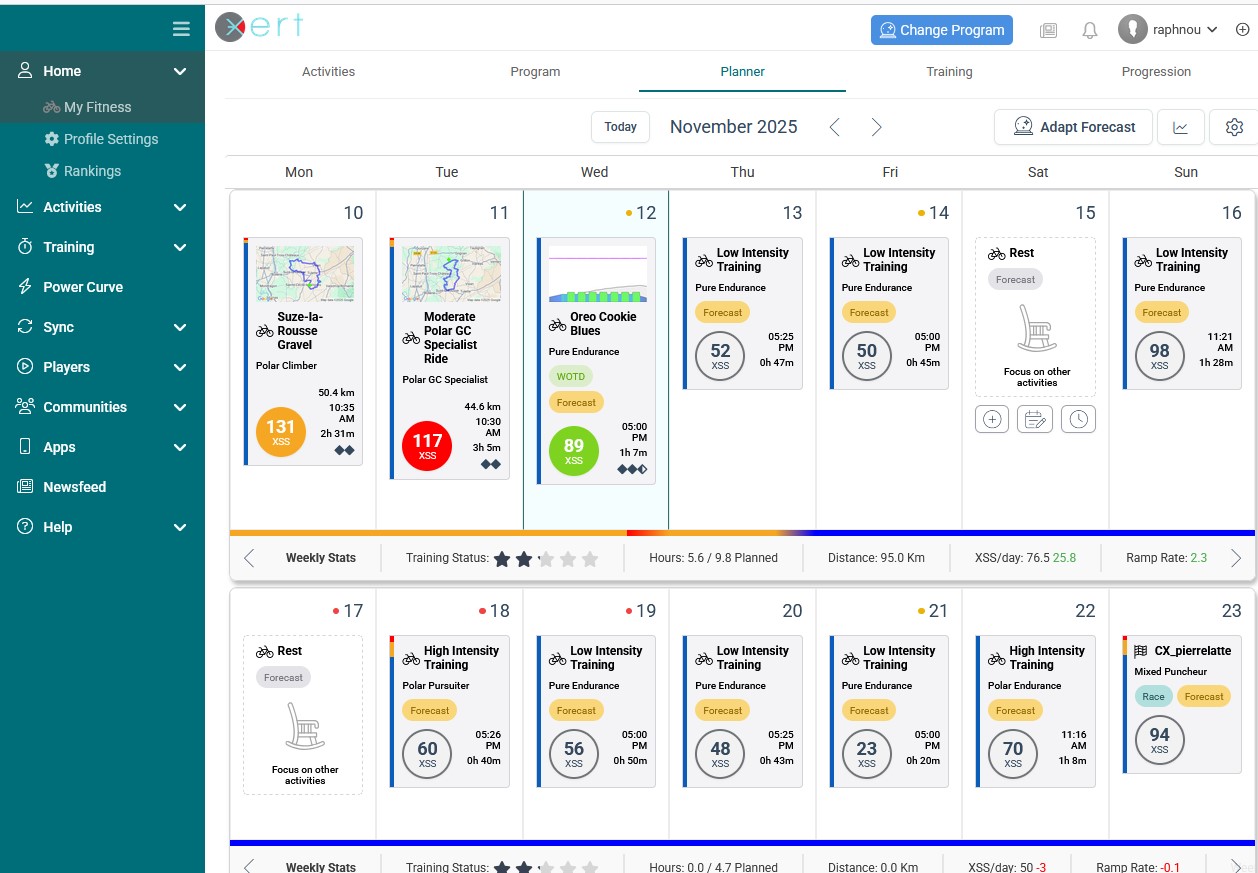

 Back off as needed (lower ramp rate, make prudent selections or temporarily adjust Freshness Feedback) and resume to “normal” when ready. If consistently feeling stretched adjust Recovery Demands or take a recovery week. Be prepared to advise the advisor. You know yourself better than any algorithm does.


 - we really appreciate your patience and interest!