Tried to find the topic in search but seem to be mostly individual account modifications.
I have two questions:
First, I Did a ramp test today after a decent amount of time off (enough to hit TL 3)
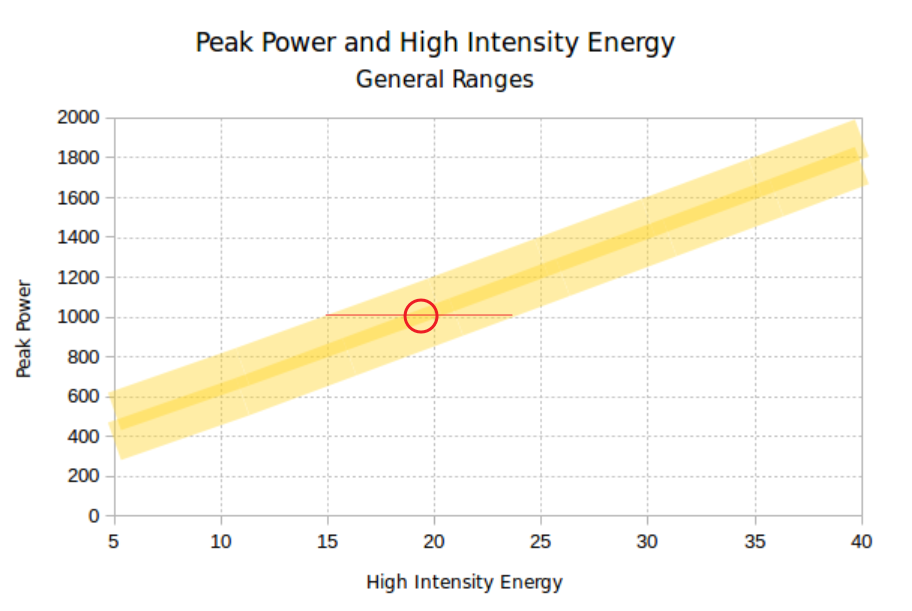
Signature before was TP 216, HIE 19.5, PP 1150, Decay has been set to Optimal
Ramp test didn’t even get close FTP 192, so I went in and used the activity to amend signature so that TP = FTP - 1 W, HIE so that the line was yellow for 5 seconds at failure, and scrubbed 100 W off PP based on a recent sprint attempt.
TP 191, HIE 12.7, PP 1050. Was this the right approach? I am assuming if its too low I’ll get a BT and it will correct anyway.
Second, and more about Xert as a whole; are there just individuals who the model just doesn’t work well for? I’ve got relatively high sprint power vs FTP and have often struggled with cases where BTs spike my HIE up in a way where really its only accurate for TP and PP but for VO2 max type efforts its not even close.
As in, I can hit over 1000 watts, and 887 for 20 s, which in some cases triggers a BT increasing HIE dramatically from what I just set (12.7) to 19+, but I am nowhere near able to match the 1 min or 5 min power that new HIE gives.
I assume you took FTP as 75% of last minute power here?
I’d probably expect TP to be a bit higher than FTP. But then ramp test is not great for everyone when it comes to estimating FTP.
Alternatively you could partially update the signature (eg TP 195, HIE 15, PP 1050) and then click ‘extract’ and see what comes out. I’ve heard signatures from ramp tests can have issues because of the sudden stop at failure though.
This is true, it will adapt with future max efforts. Also, if the ramp test was literally one of your first rides after a long break, you likely underperformed. After the first week or so back on the bike you typically improve performance a lot e.g. due to increased blood volume, and I suspect some mental resilience to hard efforts
This is harder to answer but I guess yes, and would say accuracy depends on quality and breadth of data you feed it.
I personally still try to have some max efforts for various durations rather than just relying on signature extraction (especially as in my normal riding and training I otherwise wouldn’t do very short efforts). You mention max 1-minute efforts - those are particularly hard to get right (and unpleasant when you do). I’m also cautious in accepting BTs from repeated on-off efforts as I find that can overstate my signature
Question is maybe whether it’s good enough for managing training e.g, tracking performance improvements, and helping guide workouts including both volume and focus / specificity.
Thanks for the response. Yep - FTP 75% of peak 1 min power, and expecting a quick rise once regular riding resumes. Imperfect I know.
I’d always imagined TP would be just under FTP on the basis TP is what you can sustain without drawing down MPA, vs FTP being (theoretically at least) 1 hour power, i.e. if you rode at your FTP after 1 hour you should just finish draining your MPA in an ideal system, it may be 1 watt isn’t the right assumption here.
Sounds like I might be ok to leave it and see what happens, but I’ll play with extract (didn’t know what it does so thanks for mentioning) and maybe should flag any BTs from short efforts if they spike my HIE.
Had some time to play and am now realizing it could also be PP is too low. Calculating off my best trained efforts I get PP of almost 1300 watts and the rest of the curve tracks quite well with my ‘best of 2024’ power curve.
You could use the Power Curve option to generate a signature. You’d have to do a series of tests at various durations (you may already know these values) input the values into the Power Curve Calculator, generate your signature and then input these values into a recent activity and extract and save. I do this if I feel my signature is a bit off or after a period off the bike.
You could also ask this question – Are there cases where the RAMP or 20-minute test model doesn’t work? Answer: YUP!
“All models are wrong but some are useful.”
FTP is not your 1-hour power (the myth that will never die) but for some it’s close.
All population stats are subject to a bell curve. Example –
What is it about your Xert derived signature that prevents you from effectively training?
Are ALL HIT workouts too hard under ERG control?
Is it an issue when workouts are converted to %FTP intervals and pushed to Zwift?
Or are you primarily concerned with successfully executing VO2max intervals?
VO2max is a physiological state you want to reach at whatever duration you’re able to hold (2-5 minutes) using whatever protocol it takes to get you there. That could be traditional straight blocks at a %TP that works for you or micro-interval sets (Ronnestad-style) or hard-start intervals (ex. Closer series). Choose whichever method works best for you at whatever intensity is required. Ride in Slope mode if necessary. The goal of VO2max training is not workout compliance under ERG control. It’s get there and hang there to the best of your ability on that day.
While I was originally enthralled that I could complete most HIT workouts at 100% compliance in AUTO mode (when status stars equal diamond count), I have since graduated to a foolproof never-fail-a-workout method. It’s called Slope mode + XMB to fill any remaining buckets.
Extract can be run when the activity includes a BT or sufficient maximal efforts (MPA close to power). Otherwise use Refresh/Save to tweak a signature.
Extract versus seed a signature –