The question is whether, when analysing existing training data using Xert 2.0, one can identify differences in the training stimuli. In other words, a better way of determining the extent to which the stimuli of the various energy systems affect training progress.
Not sure if I understand what you’re saying. I just realized, after years of using Xert, that they have ‘Training Responsiveness’ which looks at your breakthrough history and adjusts how the system expects additional TL in each system (low, high, peak) will affect your signature. It’s not obvious in the app (it’s under Profile Settings) but it does seem to model how your respond to different intensity stimulus. Is this similar to what you’re asking about?
To answer your question, Muscle Glucose Uptake Rate isn’t directly equal to what you eat.
It’s possible to over-eat (and have GI issues because of it). Conversely, if you eat nothing on a long ride, your muscles are still using some glucose, which needs to come from somewhere - likely released from the liver to maintain blood glucose levels. I suspect that the muscle glycogen uptake is likely a hybrid of some fixed input from our bodies plus some portion of externally sourced carbs (gels, bars, etc.). In my initial experimentation, something like 30-45g/hr makes sense for endurance rides where I didn’t eat anything and closer to 70-80g/hr (or higher) for rides where I was fueling more aggressively (usually 60-75g/hr).
Perhaps by locking the signature in place, we can try to run a couple extractions and determine what the MGUR would need to be for a variety of different rides to establish a “baseline” of valid ranges.
2 Likes
Hard to tell, but if you look closely, the power output increases a bit in the final ~30 min of the ride. Higher power output = more glycolytic demand, which is seen as the larger reduction in MPA towards the end of the ride.
Durability is based on modeled glycogen capacity, so it’s a function of how hard you’re riding (harder riding will deplete you faster, regardless of signature), as well as your fueling (higher muscle glucose uptake rate = more power you can get from blood glucose and less reliant you become on muscle glycogen). We’ve also modeled the ability to start your ride from a depleted or supercompensated/carb-loaded state (initial muscle glycogen setting).
One way that we’re thinking about it would be that while rides might rely more heavily on carbs, you only need to replenish the ‘Glycogen Burned’ amount in order to replenish your carb stores since the amount of blood glucose burned is most likely coming from an external source to begin with. Does that make sense?
Sounds good. I’m mostly going to leave it alone for now and just see how it’s different from V1 and relates to actual feel on the bike.
@ManofSteele Will 2.0 “blur” the line between low, high, and peak? What I mean is, in 1.0 I could have a TP of 250w and ride steady at 245w and that would would be entirely low XSS, if I’m not mistaken. If I’ve got that right, what’s the Xert perspective on whether the low and high zone boundary should be more fuzzy?
1 Like
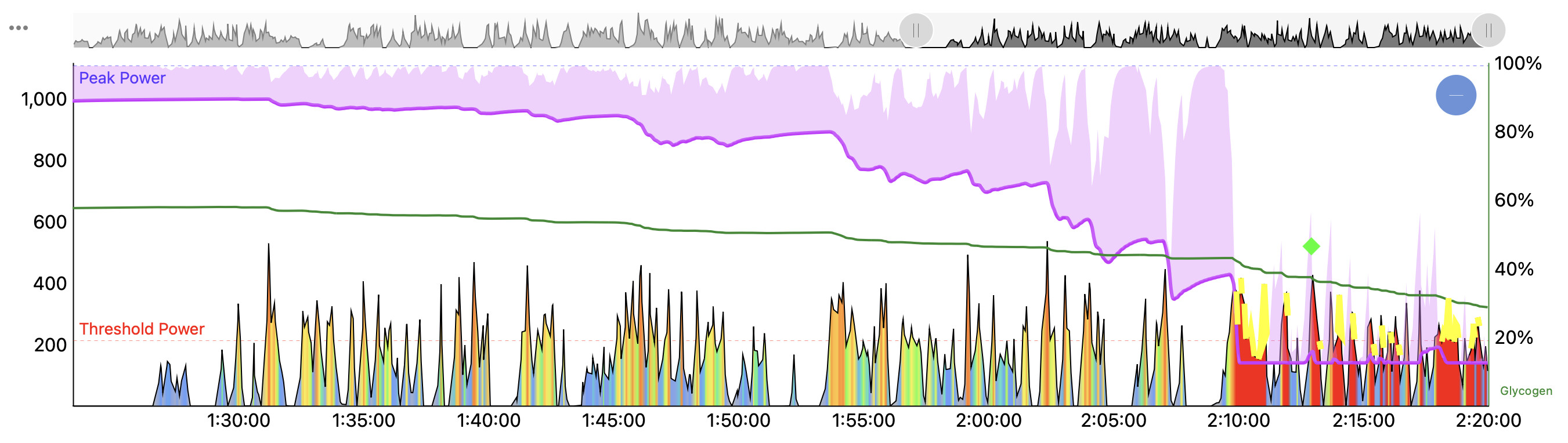
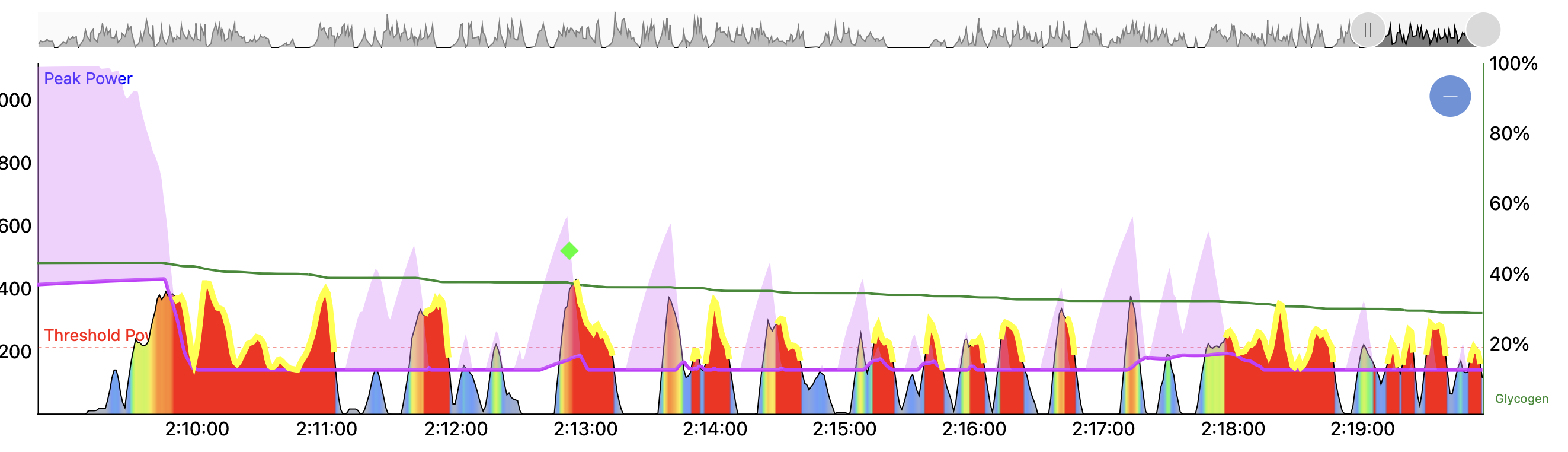
I have one of those also, but more extreme. It’s a MTB ride on terrain that’s all up or down. MPA drops to 141W (lower threshold) and sticks there, even while I’m spending a good bit of time in that last 10 minutes above 250W.
Zoomed in:
Activity ohof6rtwscni5orq
I think it makes sense, though am I right that you don’t have to replace that during the ride, just at some point before your next ride? And presumably you need more carbs for the rest of your daily energy needs. In my mind there are two things you need: 1) enough carbs on the bike not to bonk (which is probably low unless you ride very long, since you have some stored) and 2) enough energy (fat, carbs, protein, but likely flexing the carbs) to meet total energy needs on and off the bike… and there is an element of the more carbs you eat on the bike the less you need off the bike…?
Yes, this can happen and likely requires some adjustment to better fit the data. Either your signature is higher (although unlikely if you’ve had a recent breakthrough that confirms the current signature is accurate), or your muscle glucose uptake rate on this ride was higher than the default (60 g/hr).
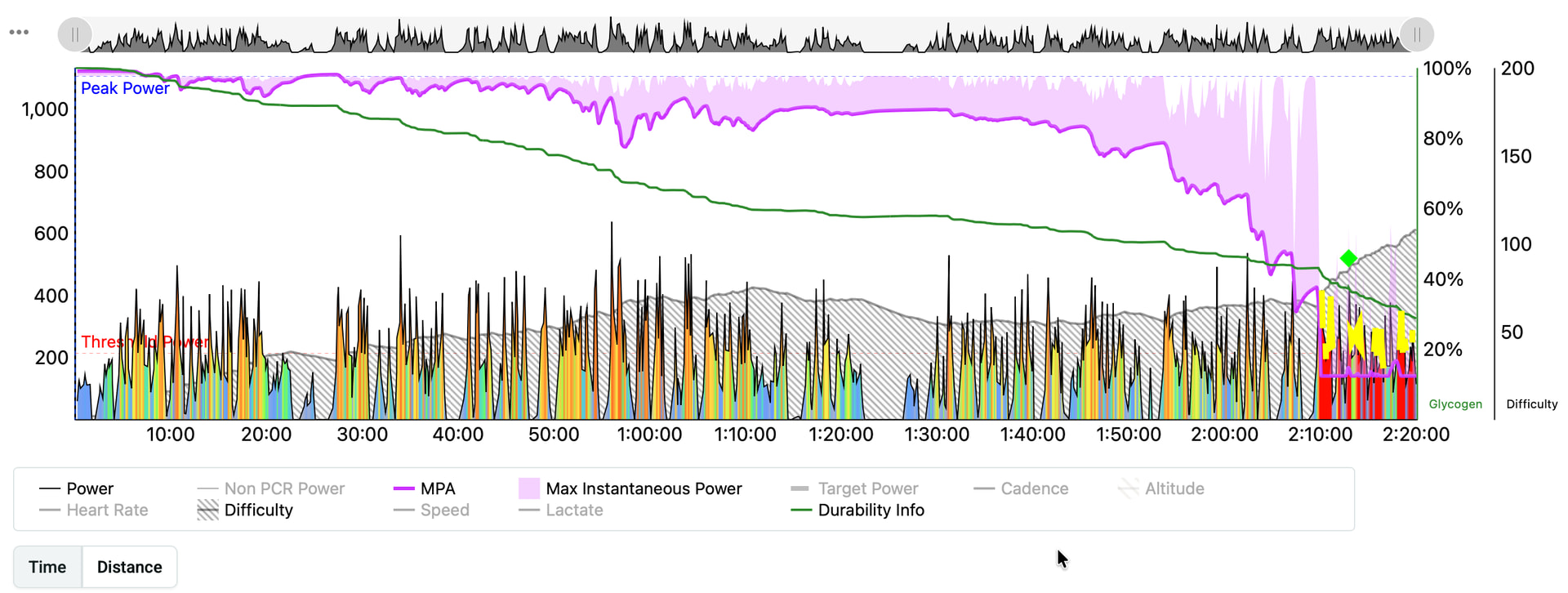
Here’s the MPA chart using the default of 60 g/hr. Because (blood) glucose uptake is lower, you’re tapping heavily into muscle glycogen, which significantly reduces your signature later. It’s actually kinda a double whammy with less glycogen available and your signature (TP/HIE) actually decrease as muscle glycogen is depleted.
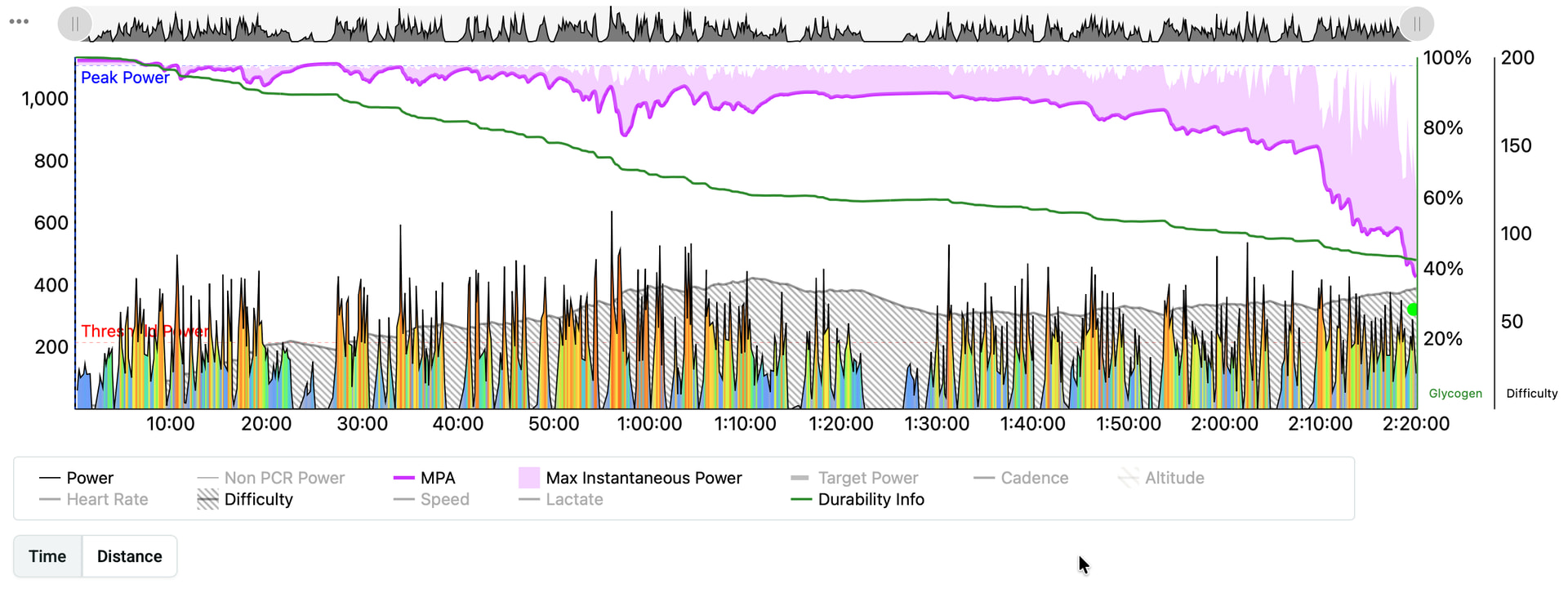
Under Fitness tab > Other Signature Parameters, you can try adjusting the Muscle Glucose Uptake rate and see how that changes things. By increasing how much fuel is available from (blood) glucose, you draw less on your glycogen stores, which keeps your signature (and MPA) higher later in the activity. For example, here I changed it to ~78g/hr, which basically gives you a BT right at the end of the activity - perhaps that’s closer to how you felt at the end? Increasing MGUR above 80g/hr will actually have you finish with even more MPA.
Correct. Sorry if I wasn’t clear.
Our initial theory is that yes, after your ride, the goal for carbohydrate replenishment would be based on the muscle glycogen depleted. Think of that as being the ‘tank’ that is emptied during exercise and needs to be topped up afterwards.
On the other hand, muscle glucose is virtually unlimited in capacity (as long as you continue eating during exercise - as you mentioned, failure to do so results in bonking), but it’s rate limited in how quickly it can be brought into muscle cells for energy (e.g. MGUR). If you eat sufficient carbs on the bike, even for a relatively easier ride, you can maintain reliance on blood glucose (and fat) rather than muscle glycogen.
Also important to note that our fat/carb estimations are just what’s used for exercise & doesn’t include basal metabolism.
1 Like
Honestly it may be more signature improvement than glucose uptake rate. I haven’t tried for a breakthrough in a few months now. I estimate my consumed carbs during the ride (1.5 stroop waffles, 1 lara bar, 1 pb&j) at 120g for the 2 hours 20 minute ride. I’ll see if I can get a breakthrough tomorrow and apply an updated signature to the ride.
Is that correct as there are at least 2 studies which show that consuming CHO during exercise does not spare muscle glycogen. A meta-analysis did show a slight sparing but it it was not apparently significant.
To say this subject is complicated would be an understatement.
https://journals.physiology.org/doi/full/10.1152/ajpendo.00376.2015
https://pubmed.ncbi.nlm.nih.gov/30840136/
https://pubmed.ncbi.nlm.nih.gov/33772787/
https://journals.physiology.org/doi/full/10.1152/japplphysiol.00861.2025?utm_source=chatgpt.com
Ha! You’re telling me. Fortunately we have a model that generally agrees with many of the underlying principles & it’ll be a matter of tuning it.
Perhaps there exists reserves in both Type I & Type II fibers. Glycogen from Type 1 fibers (slow twitch) will always be used, even at low intensities, while Type II (fast-twitch) are perhaps recruited as Type I fibers gradually become depleted or during more strenuous riding. We’ll have to model how some of this will behave.
From the existing model… When glycogen stores are full, riding near LTP would still draw quite heavily on slow twitch muscle glycogen (as proposed). However, as those stores are depleted, you’ll see a leftward shift in LTP (i.e. LTP decreases) and a heavier reliance on fat, since the power still needs to come from somewhere, even if glycogen stores are being depleted.
Pay attention to how the fat contribution increases at all intensities below TP and how LTP shifts leftward from ~180 W to ~130 W as glycogen is depleted:
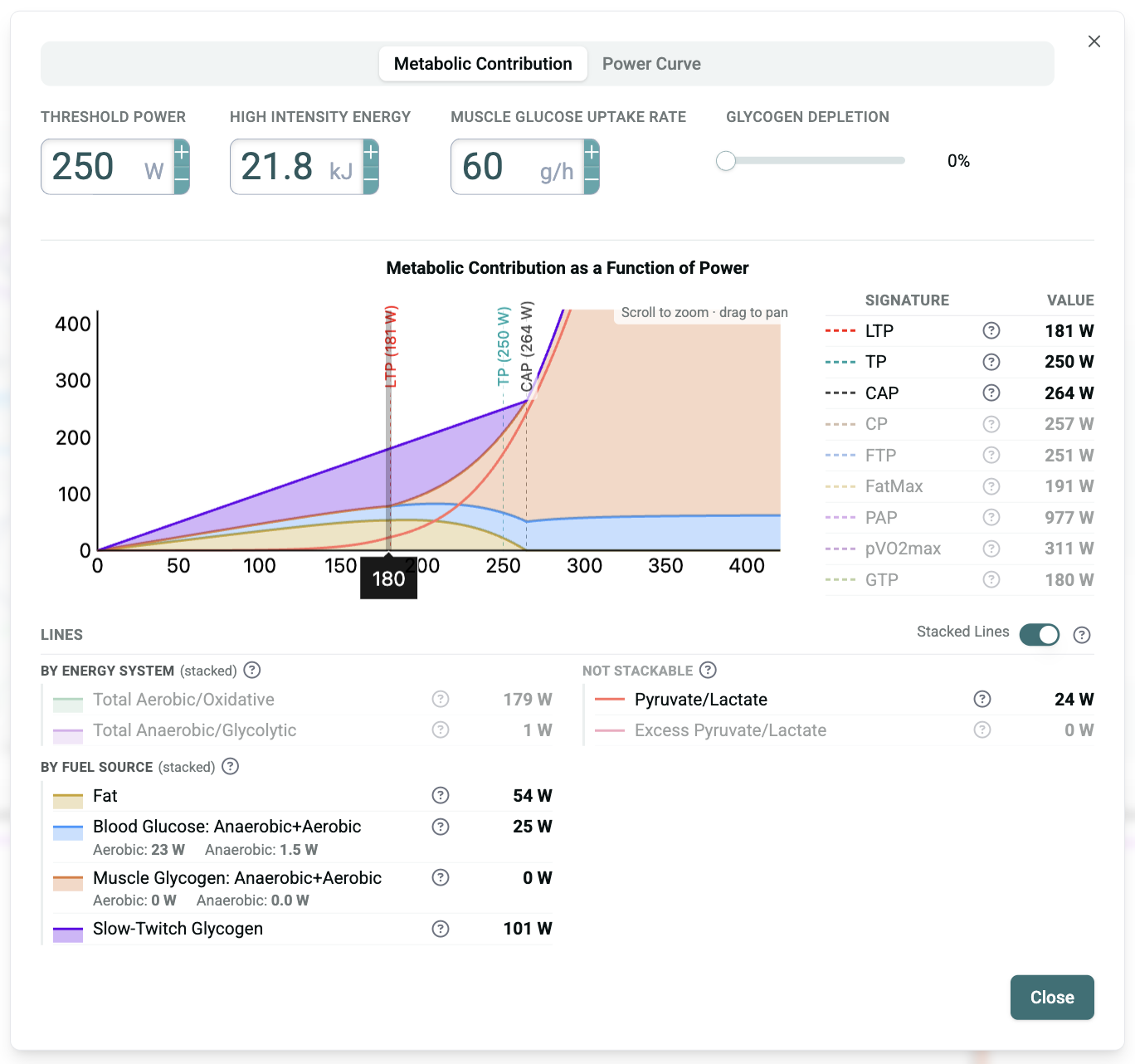
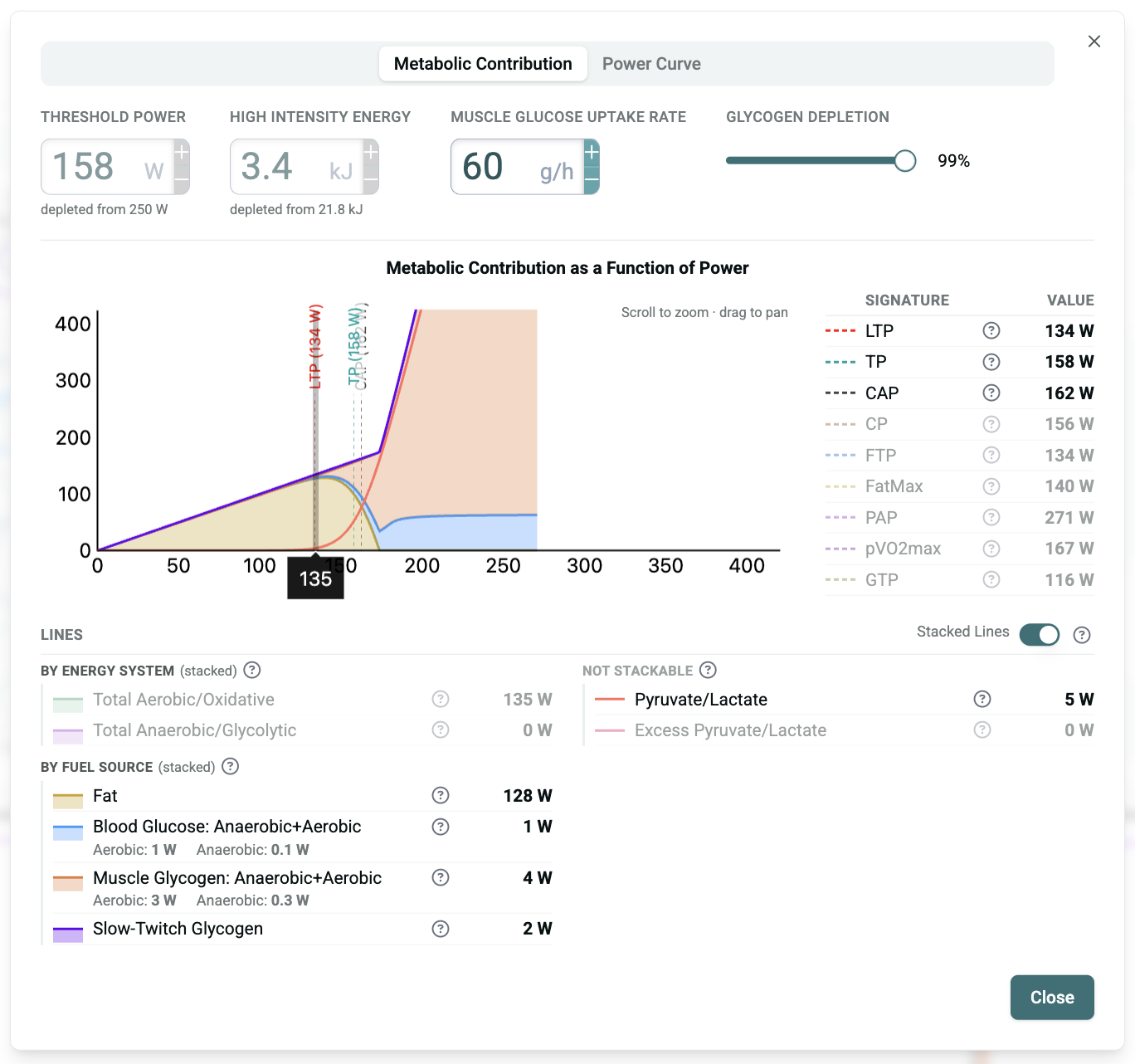
2 Likes
Thanks. There is certainly a lot to mulll over when I get back in front of my laptop when I’m home.
You said you modeled the ability to start my ride from a depleted/loaded state. How can I - as a user - know what my current muscle glycogen is? I sure know how much I ingested, but as you stated multiple times: it’s not the same as the muscle gylcogen.
Also: right now when I click on beta2.0 "depleted seems to always be pre-selected. Shouldnt it be the other way around?
Best solution for now is to estimate.. you could use my advice above about aiming to eat back carbs equal to the muscle glycogen depleted following your rides.
You’re right that ‘Depleted’ is selected, but the amount is defaulted to 0g. To use this feature, you would choose between depleted or loaded, then enter the amount of grams depleted (or super-compensated/loaded).
Perhaps in the future we could predict starting levels by looking at your recent ride glycogen burn during activities and the time since them (assuming there are numbers that estimate how quickly muscle glycogen stores are replenished.
Alternatively, we could simplify it a bit and use a rough estimate as part of a “pre-ride checklist” in the Xert EBC app (Initial Muscle Glycogen level, or something similar). The app could then factor the starting depletion to alter your signature/workouts targets - pretty neat to think about the possibilities!
For example:
- If you had good meals after your recent hard training and/or ate before your ride, you’re probably topped up (~100 %).
- If you didn’t eat enough after recent hard training, and especially if riding fasted early in the morning, perhaps you’re only 3/4 full.
- And if you really carb-loaded for a race/event, maybe we can assume your levels are extra-full (~110%).
2 Likes
I also have a question regarding the Muscle Glucose Uptake Rate (MGUR).
In my mind, if I have, say, a 3 hour race and set the MGUR to 120g/h (just an example), I would expect the “GLUCOSE USED“ number to be 3h*120g/h = 360 g.
Okay, maybe the start phase is easy and therefore I am hitting my muscle glycogen ceiling, but if I enable the setting “Supercompensation“, I should be seeing the 360g? Or am I missing something here?
The number I am getting is (Supercompensation enabled) only about 77% of what I expected.
If I assume a 200g depleted initial state, its still only about 86% of what I expected by the set MGUR.
Or is there another ceiling applied, even with the supercompensation enabled?
For testing purposes, it would be nice to have Xert 2.0 applied to the workout builder, so that you can also play around with different scenarios.
1 Like
Did a tough XMB ride with a hard effort near the end today and the MPA curve of the beta matches way better how I felt than that in the current version 

Edit:
I also noticed that the difficulty rating for my latest ride is significantly different with the 2.0 Beta: 112 vs. 141 (current).
I don’t know whether this is to be expected and which one is right.
I just wondered about the lower difficulty rating in the Beta when MPA is lower after lots of intervals than in the current model.