I have been using Xert for 2-3 weeks. Before that I had been using Trainer Road over the winter, which estimated my FTP at 195-200W. The TR workouts were consistently challenging but doable. Then I decided to try Xert because of Magic Buckets.
After importing my workouts from Strava into Xert (over a year of workouts), Xert set my TP at 165 or so. Then after a few outside rides with all out sprints Xert bumped my TP to 218. It seems to be eay too high. Now I keep failing Xert workouts on the trainer. “Radar Love” felt impossibly hard, I failed it. Yesterday I did “No time to cry”, which was supposed to be 2,5 dots aerobic, but it felt like hard threshold work, I had to make a pause midway, otherwise I would not finish it.
I have XATA continuous plan. My progression rate is set to Moderate 1, my recovery demands and xss/h are set to default. Polarization is set a bit to the left, as recommended in one of Xert podcasts (but it seems that this slider does not affect the recommended workouts in my case anyway).
What should I do?
For now I flagged the two sprint workouts, which bumped my TP to 217. That lowered my TP to 203. My plan is to do an indoor Xert Fitness Test and verify my TP that way.
But I am kind of disappointed, I was hoping that Xert would determine the signature automatically without having to do FTP tests - that seems to be the Xert promise.
Xert is known to over estimate TP if you perform a sprint that abruptly stops. A better way to get a valid breakthrough in regard to TP is to draw MPA down to your TP value and hold it as long as you can. “Xert Fitness Test for Breakthrough“ workout is an example of this.
Thanks! I have a Wahoo Trainer with only one gear, the Zwift Cog. So in practice I can only do Xert EBC rides in Auto/ERG mode. Once I start failing an interval, the ERG death spiral starts, so dropping to TP is not really an option. Any suggestions how to handle this?
Also, what I don’t really understand - one of Xert’s big selling points is that its fitness signature consists of 3 values, the TP, HIE and PP. Which in theory is more accurate/informative than having just FTP. So my intuition would be that if I do an all-out sprint and hit a PP breakthrough, then my PP is increased, HIE maybe too, but TP should basically stay the same - that sounds like the natural benefit of having 3 separate signatures. But if my PP increase automatically increases my TP to an unrealistic level, then the whole point of having 3 separate signatures for 3 separate types of effort seems lost to me. I’m sure there is advanced math and modelling behind all that, but at the end of the day all I really care about is having a system that recommends me workouts with proper difficulty and that seems to be less straightforward with Xert than with Trainer Road.
Post a link to one or both of those workouts so we can see what the failure points look like
(View activity details, select Share, set to Public, and copy the url.)
No formal FTP tests are required for Xert.
A few 10 sec sprints now and then plus occasional maximal efforts under fatigue should suffice (anywhere along your power curve).
You can manually tweak your TP if necessary and set decay to Small or No Decay.
To do that view last activity, edit signature below chart, and Save (lock).
Once signature is dialed in changes to TP will occur based on TL alone. No BTs required although most users will attempt BTs when the opportunity arises. Other users will ride for months without a BT.
Do you plan to utilize Magic Buckets outdoors?
It’s impossible to fail target goals on Magic Buckets since the app adjusts based on your execution. You control the difficulty level and recovery duration between intervals.
Do you still have a cassette available for your trainer?
I don’t have any experience with a Cog, but it sounds like you can use one in combination with Zwift to effectively ride Mixed Mode workouts with virtual shifting.
See these related posts – Search results for ‘zwift cog’ - Xert Community Forum
Post a link to one or both of those workouts so we can see what the failure points look like
(View activity details, select Share, set to Public, and copy the url.)
Here are both the rides – they are currently flagged.
No formal FTP tests are required for Xert.
A few 10 sec sprints now and then plus occasional maximal efforts under fatigue should suffice (anywhere along your power curve).
That’s more or less what I was trying to do with these rides, to help Xert calibrate my fitness signature.
There is a relationship between PP, HIE, and TP.
I understand that, but I’m not sure this is helpful in my case. It seems like this relationship is what is getting me into trouble in the first place - my understanding is that my sprints increased my PP, and my PP in turn increased the TP to an unrealistic level. But I might be wrong.
Thank you, I have read that. It basically confirms that the power signature detected by Xert can be wrong – it seems to be my case. But I’m not sure what to do about it (other than to do a fitness test, like I described.)
You can manually tweak your TP if necessary and set decay to Small or No Decay.
To do that view last activity, edit signature below chart, and Save (lock).
Decay does not seem to be a problem – the TP is too high, not too low. Setting TP manually… I don’t know, sort of defeats the purpose of having Xert as a reliable fitness platform. I was hoping Xert would do the thinking for me, not the other way around.
Once signature is dialed in changes to TP will occur based on TL alone. No BTs required although most users will attempt BTs when the opportunity arises. Other users will ride for months without a BT.*
Ok, but I can’t finish workouts with TP at 217.
Do you plan to utilize Magic Buckets outdoors?
Yes, I plan and have used both Magic Buckets outdoors and Xert EBC indoors.
It’s impossible to fail target goals on Magic Buckets since the app adjusts based on your execution. You can control the difficulty level and recovery duration between intervals.*
My failed workouts were on Xert EBC, on an indoor trainer. These were workouts recommended by Xert based on the inflated TP signature.
Do you still have a cassette available for your trainer?
No, I never had one, my Wahoo trainer came with the Smart Cog.
I don’t have any experience with a Cog, but it sounds like you can use one in combination with Zwift to effectively ride Mixed Mode workouts with virtual shifting.
See these related posts – Search results for ‘zwift cog’ - Xert Community Forum
There is nothing wrong with manually tweaking a signature to establish a reference point in time and move forward from there.
The ability to do so – and play what-if scenarios – is an inherent feature of Xert.
I meant send links to the two indoor workouts (Radar Love and No Time to Cry).
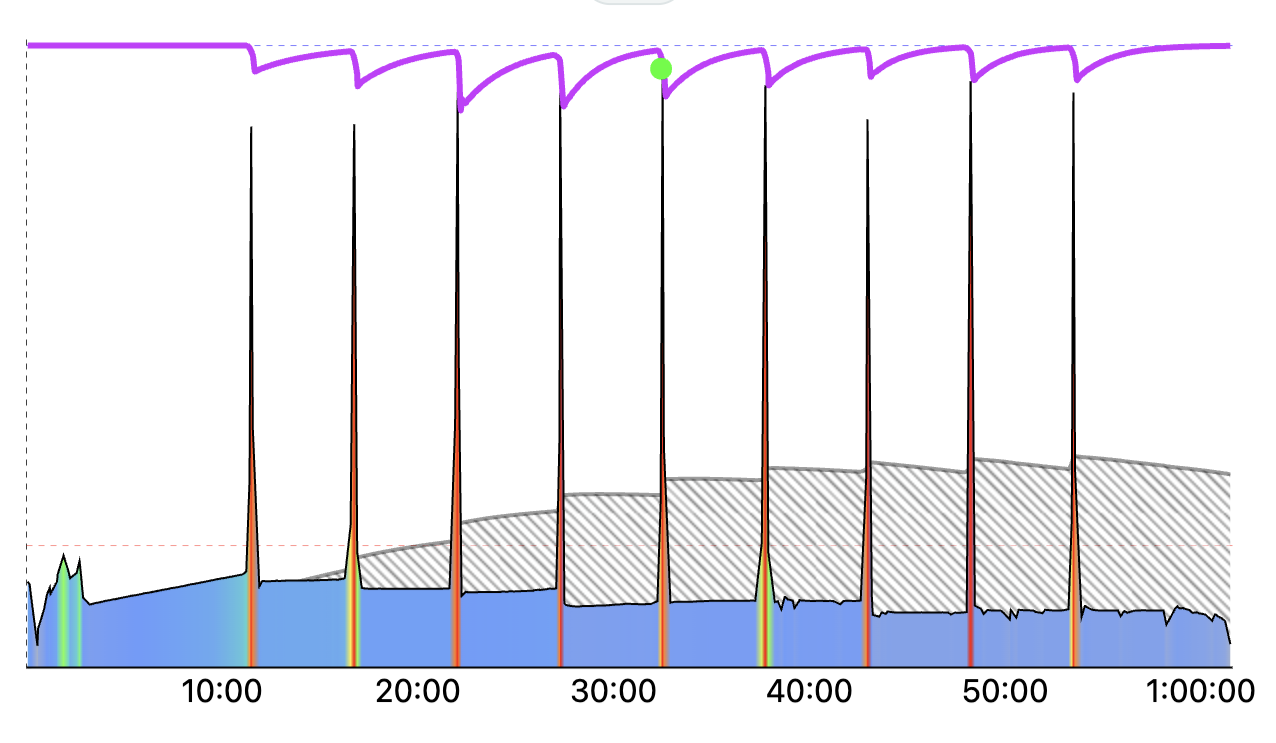
The first ride link (Random Xert) demonstrates TP is too low since Difficulty Score (DS) rose above 200 and multiple BTs were detected (yellow lines).
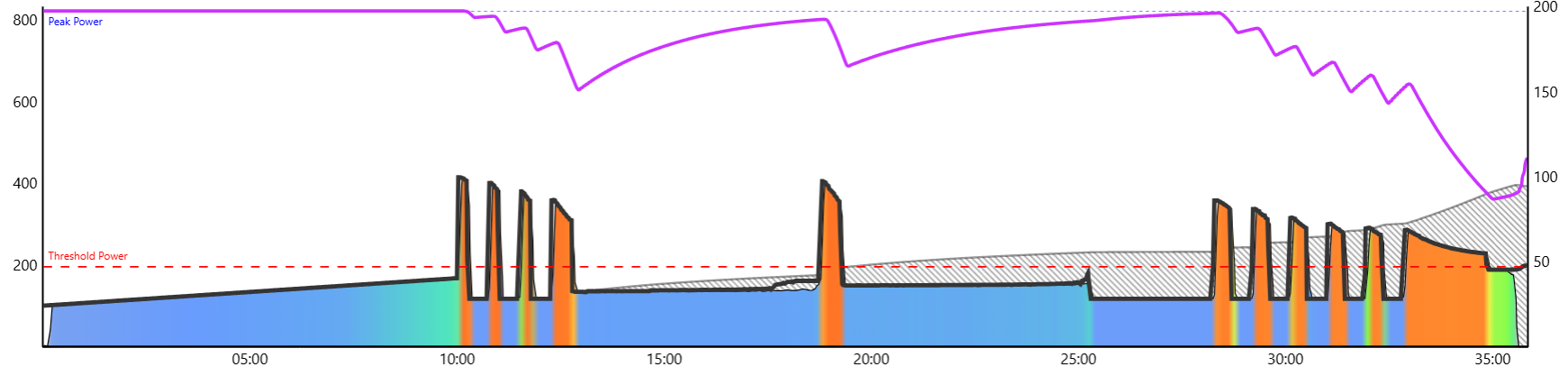
The second ride shows an abrupt stop at the BT detection point which is a common reason to flag an activity that bumps TP unrealistically. Flagging is also an inherent feature in Xert. Another arrow in Xert’s quiver.
Xert works best as an interactive platform. That doesn’t mean you can’t set it and forget it but if you want the best results you should plan to “advise the advisor” whenever the need arrives.
You are learning how to self-coach and determining what works best for you.
Here’s your first what-if experiment –
Go to the “Random Xert” activity, bump TP by 2-3 pts below the chart, and hit Refresh.
That should normalize the Difficulty Score (shaded portion of chart) and reduct the BT detection segments.
E.g. does TP set to 203 or thereabouts lower DS to a max of 150 on the chart?
Save the value you’d like to use as a reference point moving forward.
Keep in mind TP is not meant to match FTP as they aren’t derived in the same manner.
I’ll try with the experiments you suggested, thank you.
“TP is not meant to match FTP as they aren’t derived in the same manner” - Sure, but as long as TP is used to scale my workout difficulty, it needs to be correct, whatever that means.
I guess I’m more of a “set it and forget it” kind of user, maybe that’s why I get frustrated by these issues.
Anyway, what would be the easiest way forward for me, to get to a reasonable fitness signature, and keep using Xert without big hiccups?
Regarding fitness test with with only one gear (Zwift Cog) - I don’t have Zwift or Rouvy subscription. If I need to subscribe to one of these services just to be able to do fitness tests for Xert, it gets a bit expensive.
Are you using the same power meter indoors and outdoors? You really shouldn’t find that ‘no time to cry’ workout difficult even if TP was over-estimated by 10% - they are only very short intervals barely above your (lower) TP estimate with lots of recovery… difficulty was getting high-ish at 70 but with your training load it should be fine
If power is consistently measured inside and outside, other things to consider would be 1) cooling indoors 2) other reasons for power differences indoors vs outdoors (e.g. static bike, psychological differences) 3) fuelling / hydration 4) fatigue. For the indoor vs outdoor differences, if you will mostly do structured rides indoors it makes sense to get your breakthrough indoors too (either a test, or just a ride like you did outdoors, but indoors… you can adjust resistance or slope using the Xert app… or you can use your monthly free kms in Zwift on a climb up Alpe du Zwift if you want to use virtual shifting ). You will need to keep flagging outdoor BTs in that case.
re: one of your other concerns, increasing PP should result in a lower TP all else equal - the earlier comment about sprints leading to inflated TP is incorrect. You should actually make sure you have an accurate PP from a fresh all-out sprint… if you can put out more than the 820w in your current signature, that’s in fact a reason for TP to inflated. (If the intention of the other comment was to say that ‘sudden stops’ rather than ‘natural failure’ can distort the signature, that is apparently true, however that doesn’t seem to the issue in your outdoor BT efforts).
You are spot on, my indoor and outdoor power sources are different - I use Wahoo trainer for indoor and 2 sets of Favero Assioma MX1 pedal (one-sided) for my 2 outdoor bikes - gravel and MTB. Yesterday evening I did a quick indoor ride with both the wahoo and the Favero (the MTB one). ChatGPT analyzed both fit files and sait there Favero showed consistently 4%more power.
Now I will do some more testing - the TP spike was from the other Favero set (the gravel one). I will report back with the results.
As for your comments regarding PP and TP - I’m afraid I am a bit confused. Were you referring to my remarks or some other poster’s?
Glad to help. Using different power meters is an issue… comparing one-sided to two-sided results can be another (or the) driver e.g. if you have L/R imbalance
Both… e.g.
So just noting your misunderstanding which is in response to the other post… again, a PP increase will in fact lower TP all else equal… an ‘abrupt stop’ can cause issues but don’t think that’s the case
I haven’t looked at the math behind the Xert model, but I had a similar situation the OP is referencing. 6x15sec sprint workout with sprints ~200W higher than anything I’d done this year. PP jumped by that same +200W but Xert also added ~+30W to my TP. There were zero other efforts in the workout other than Z1-Z2 recovery between sprints. So I’m not sure the assertion that higher PP results in lower TP is absolute.
I did say all else equal… were you fully recovering between sprints (according to the old signature with the lower TP)… if not, you will be using low intensity / TP as well as peak power when you do repeated efforts
Yes, fully recovered. Literally, sprint for 15 seconds, MPA drops slightly, 8 minutes of Z1 recovery (plenty of time for MPA to fully recover), sprint again. Rinse and repeat. Wasn’t testing anything other than absolute sprint power and basically no time above, at or around TP (other than those 15 second sprint that were obviously well above TP).
That’s the workout. The MPA curve there isn’t the original signature that Xert calculated. It was suggested in another thread that I enter a more appropriate starting PP and have Xert re “extract” the signature. When doing that, using almost the exact PP Xert ultimately arrived at, but using it as the starting point for the signature going in, Xert only increased my TP by +2-3W…
Guess it was 9x15 seconds, but point stands. That workout above, when not fed a more accurate PP, resulted in +30W added to my TP. Versus when I primed it with a more correct PP my TP only moved marginally up (I suspect it could be as simple as my training load has been increasing rapidly, +5-7 TSS/day/week, as I’m coming off an extended break from cycling).
The fitness test workouts are examples of what type of efforts generate BTs or Near BTs.
You can do the same thing outdoors when riding along depending on the route and efforts produced.
All you want is a viable ballpark signature to start training with Xert.
Users without a history to import will plug in their estimated values.
If you feel calculated TP is too high after a BT detection, lower it, save that change, and move on. If the PP bump was valid, you would retain it.
I suggest you disable power smoothing on your Wahoo so you get a clearer picture of power being produced. That won’t adversely affect BT detection and XSS analysis, but there’s no point viewing perfect intervals when they weren’t.
Your Radar Love - 90 workout shows full compliance for 35 minutes until you stopped after the first declining micro-interval set switched to “hard easy” for the recovery.
That’s a hard workout segment. Completing at 100% is a challenge especially if that was your first time. You were close to finishing the hardest portion of the workout. Easier sets followed.
Most Xert curated workouts taper in some fashion (target watts and/or durations). Many include easy-pedal breaks mid-way through. Time to hydrate and fuel.
Are you able to switch into Slope mode with a Cog if an interval set becomes difficult to handle? Or lower intensity % rather than abandon a workout.
With XATA Continuous your HIT days are determined by the Focus Duration you’ve selected under Program settings, but you can pick from a range of daily workouts that meet that goal.
Some will be easier to execute than others. Over time you’ll recognize which chart profiles work best for you and which are going to be the toughest to push through.
You can like/dislike workouts to affect their position on future recommended lists.
You can also change the Focus Duration target by either setting it periodically. E.g. change from Breakaway Specialist (5-min power) to Climber (10-min power) for weks at a time. Or simply use Filter and change Focus on-the-fly before you make a selection.
The overall goal is a HIT or LIT workout with a target XSS value which also doesn’t need to be exact.
Xert is likely a lot more flexible than what you are used to.
You’re also about to discover that with Magic Buckets outdoors it’s impossible to “fail a workout” since the app pushes you into meeting the low/high/peak strain targets at whatever difficulty level you’re capable of on that day.
Magic Buckets works indoors too although I see why that’s impractical with a Cog.
While not ideal, how quickly does resistance change if you switch to Slope mode and vary %?
still, for a given BT activity, if you increase PP (which also generally increases HIE), you will need to lower TP in order to have the MPA line just touching the power line (definition of a BT). The only way all parameters are increasing is if there is a genuine increase in your overall expressed fitness. You can just play around with it in a BT effort and see for yourself
It’s all very much over my head. To me the relationship between PP, HIE and TP is confusing to the point that I don’t care anymore I just hope I will be able to get Xert to recommend me the right workout difficulty. Hopefully sorting out the power meters will get me closer to that objective. In the meantime - time to ride my bike!
I’d generally agree with that. I’m probably a relatively unusual case since I was training 14-16hr/week until last April when I had to take a full stop break. So my ramp this spring probably looks more like signature inaccuracy when in reality a lot of it is just fitness coming back insanely quickly. My hour power metrics week-over-week were increasing by 10-15W for the first 6 weeks or so I was back on.
All that to say, I’d wager a lot of money there are more sets of circumstances that make PP / HIE / TP models breakdown or at least need a lot more monitoring than we’d like to think.

 –
– ). You will need to keep flagging outdoor BTs in that case.