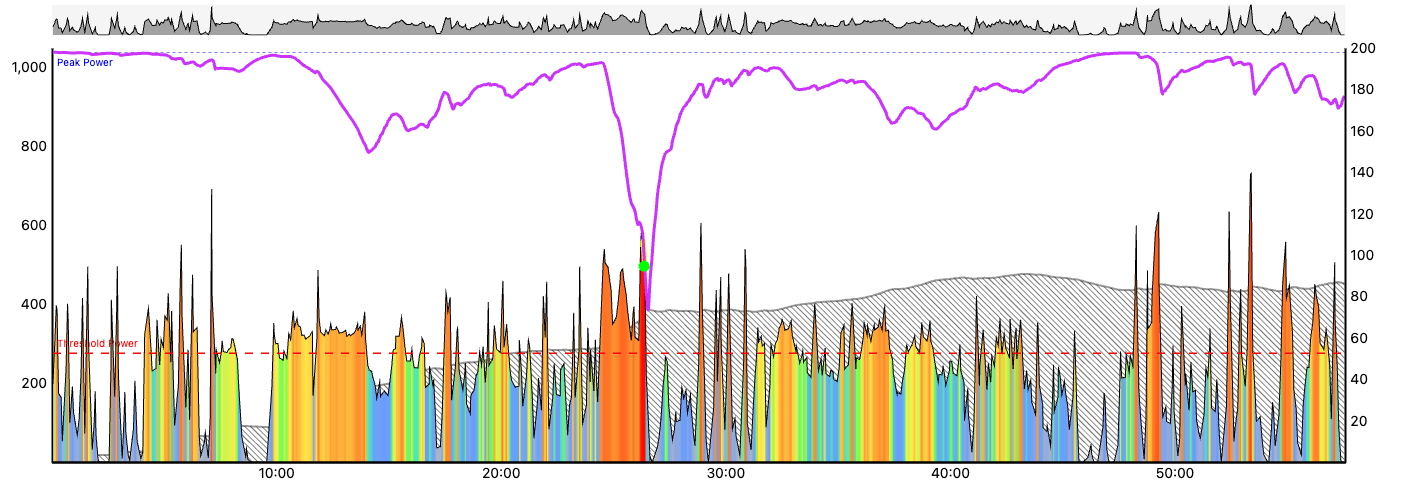
I’d like to understand how Xert estimates carbs and fat burned. The numbers on one of my rides don’t seem to add up. For reference, i’m talking about the beta charts.
Ride: Difficult Mixed Puncheur Ride, 57 min
Work: 714 kJ, avg 207 W, max 816 W
HR: 156 avg, 191 max
XSS: 90 (79 Low / 9.4 High / 1.3 Peak)
Xert’s estimate: 221 g carbs, 3 g fat, 742 kcal (glycogen 198 g, glucose 29 g)
What I don’t follow:
Carbs vs. calories: 221 g of carbs at ~4 kcal/g is about 900 kcal, which is more than the 742 kcal total Xert shows. What energy value per gram of carbs does Xert use?
Fat close to zero: 3 g of fat means almost 100% carbs. Most of the strain (79 of 90 XSS) was low-intensity, so I’d have expected at least 15–25% of the energy to come from fat.
Carb burn rate: 221 g in 57 min is about 3.9 g/min on average. That’s close to the maximum carb burn rate usually reported, which seems high for this ride.
Context: I had a breakthrough during this ride and my threshold power went up by 7 W.
Was the activity analysed with my pre-breakthrough fitness profile?
Would re-analysing it with the new profile change the carb/fat split noticeably?
Which inputs drive the carb/fat split most: threshold power, HIE, peak power, or HR?
I’m mainly trying to work out how much to refuel, so I want to know whether 221 g is a realistic target.
During high intensity efforts, carbs are burned at a high rate, even more so for hard (red) efforts in your ride. The aerobic energy formed after these efforts is burned with lower intensity efforts. But if your ride is short and you don’t do much lower intensity, you be left with a lot of energy unused. So your carb count will be higher than the total work you performed.
This is a known physiological phenomenon and something that simply computing carb count based on total work doesn’t capture.
To add to @xertedbrain 's comment, we had previously discussed this internally and decided to add a dropdown to the substrates & energy widget (Additional Energy) that shows you what happens with all the ‘extra’ carbs that were burned during the ride
Built up lactate can be burned efficiently at lower intensities (e.g. you use the built up lactate as fuel rather than drawing on more fat/carbs). This is why it’s often recommended to continue pedaling after hard/exhaustive efforts - keeps the lactate moving into the muscles to be burned up, rather than just ‘sitting’ in your muscles.
Accumulated lactate can also be re-converted back to glucose (Cori-cycle or gluconeogenesis), but this is energetically very expensive for the body and unlikely to happen during exercise, especially hard exercise. It also takes time, so not like you can use lactate to replenish glucose immediately after hard efforts. More likely to happen during recovery period after your ride.
In your ride, you had a lot of hard efforts (lots of orange/red in the chart), but no extended periods of steady, low-intensity riding (blue) which is where your body could efficiently burn that accumulated lactate.
To answer your question:
The Energy & Substrates widget has a ‘details’ dropdown. Clicking that will show a ‘glycogen depletion’ value at the bottom. This shows the estimated glycogen depletion, which is what we think likely needs to be replenished after a ride.
Interesting thread. I had a similar head-scratcher after a breakthrough ride a while back and the carb number looked way off at first. way off at first. The explanation about hard efforts burning carbs so fast makes a lot of sense.